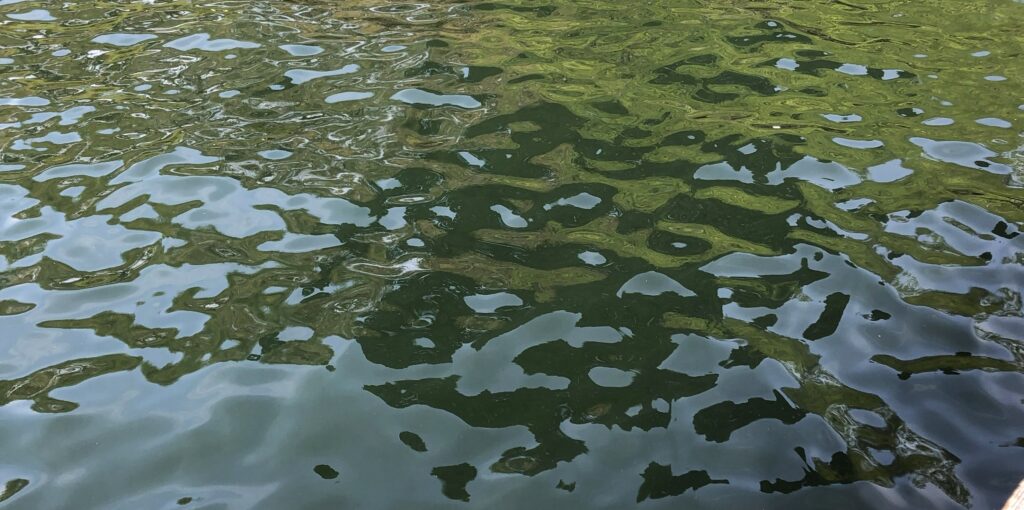
On a gently rippled lake, look near the boundary between reflections of land objects and sky. If you are close enough to see the ripples, you may be entertained by the wonderful patterns of light and dark as in the photo above.
Lynch and Livingston* call the distorted reflections of the sky within the darker region as “skypools” and the similarly distorted reflections of land (or other relatively dark things on land) within the light regions as “landpools”.
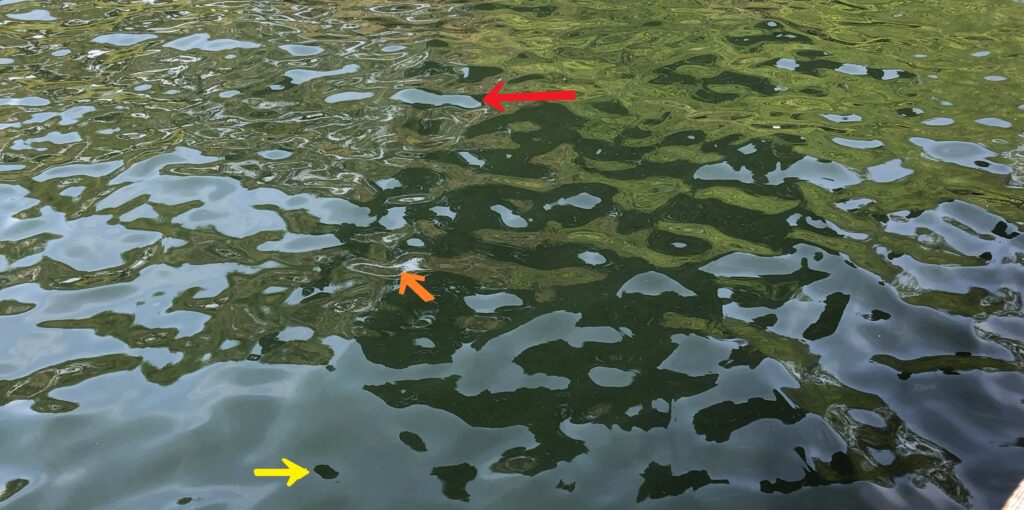
In the above annotated image, one landpool is marked by a yellow arrow, one skypool is marked by a red arrow. But what do we call the distorted light ring at orange? How about “skyloop”? Some of these skyloop light curves do not form clear loops, yet many do. All three patterns clearly exist because the water surface has hills and valleys.
Lynch and Livingston argue that the skypools arise as a double-image of the sky from a concave low up to a convex high on the side of a small wave. (Refer to sketch at bottom.) You might, if desiring of a puzzle, try to figure out other reflections.
In the meantime, here are a few more of these ever-changing patterns and a rough explanation at the end.
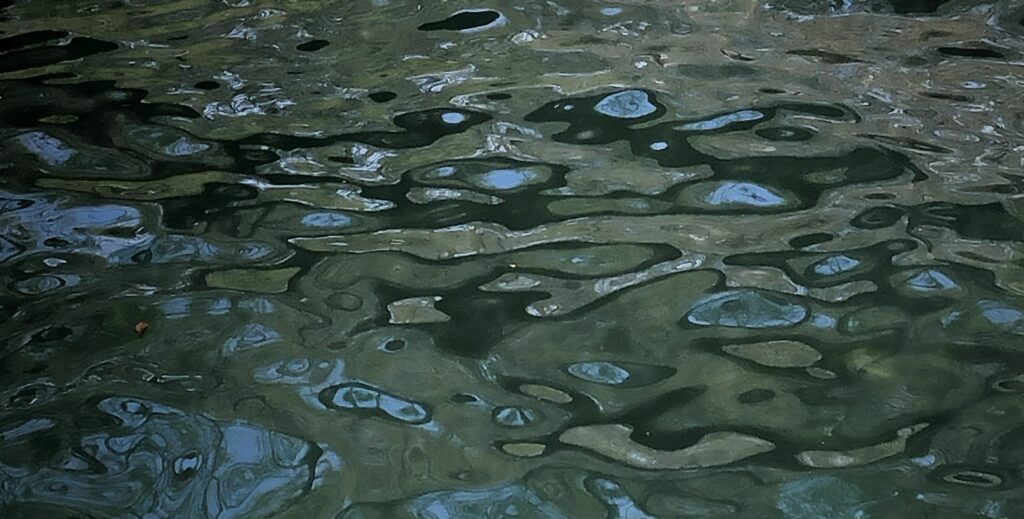
The shot below has a skypool in the shape of a duck’s head, as well as a real duck to compare to. See if you can find both duck heads!
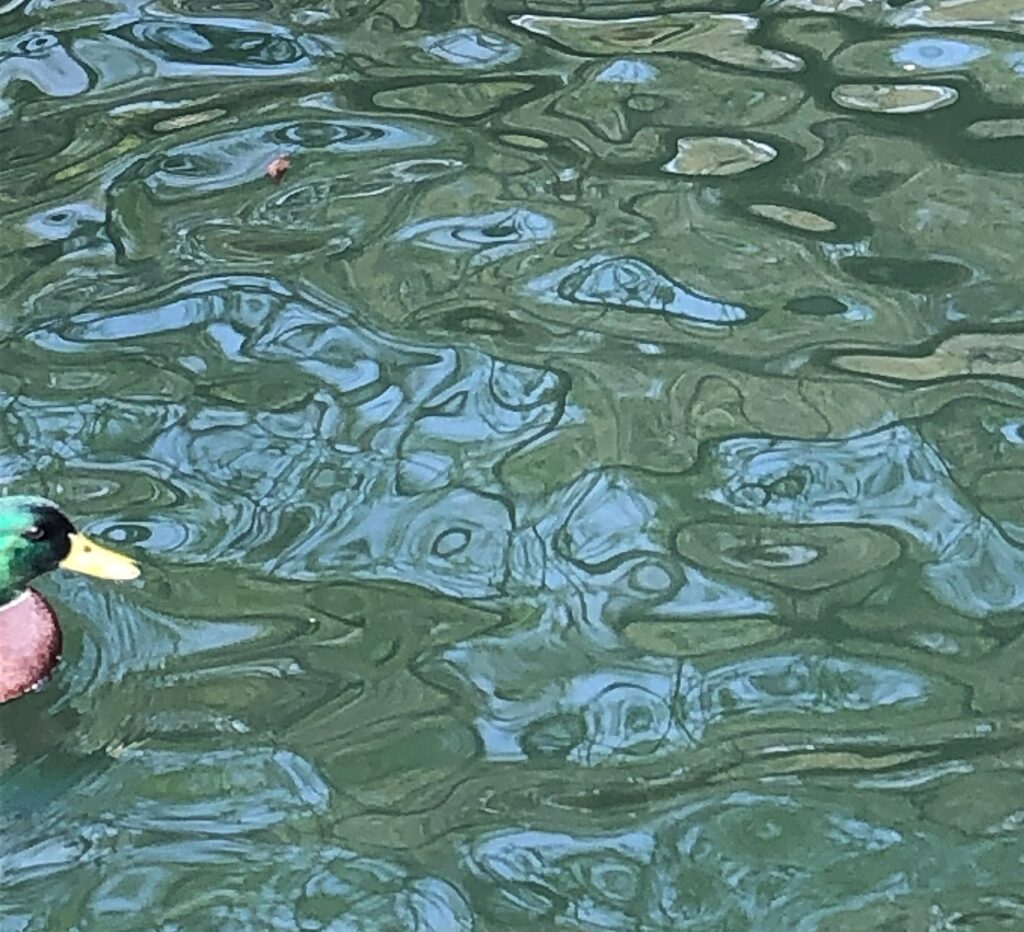
And below shows a larger area of the same region. In the above shots, the dark patches are from trees on the shore, with one tree only about 30 feet away. The sun is behind me, but shining through a veil of cirro-stratus and also not directly behind so I do not cast a shadow near these images.
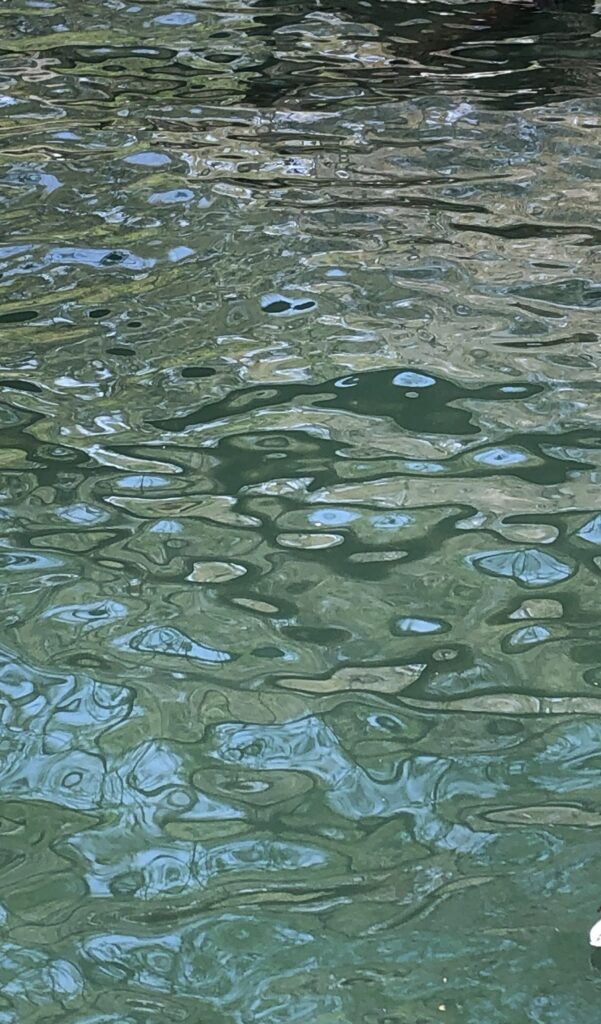
Look for them near a pond or lake near you on a relatively calm day.
As far as a brief explanation about why they tend to form oval-like pool shapes, consider how a skypool arises in the rough sketches below.
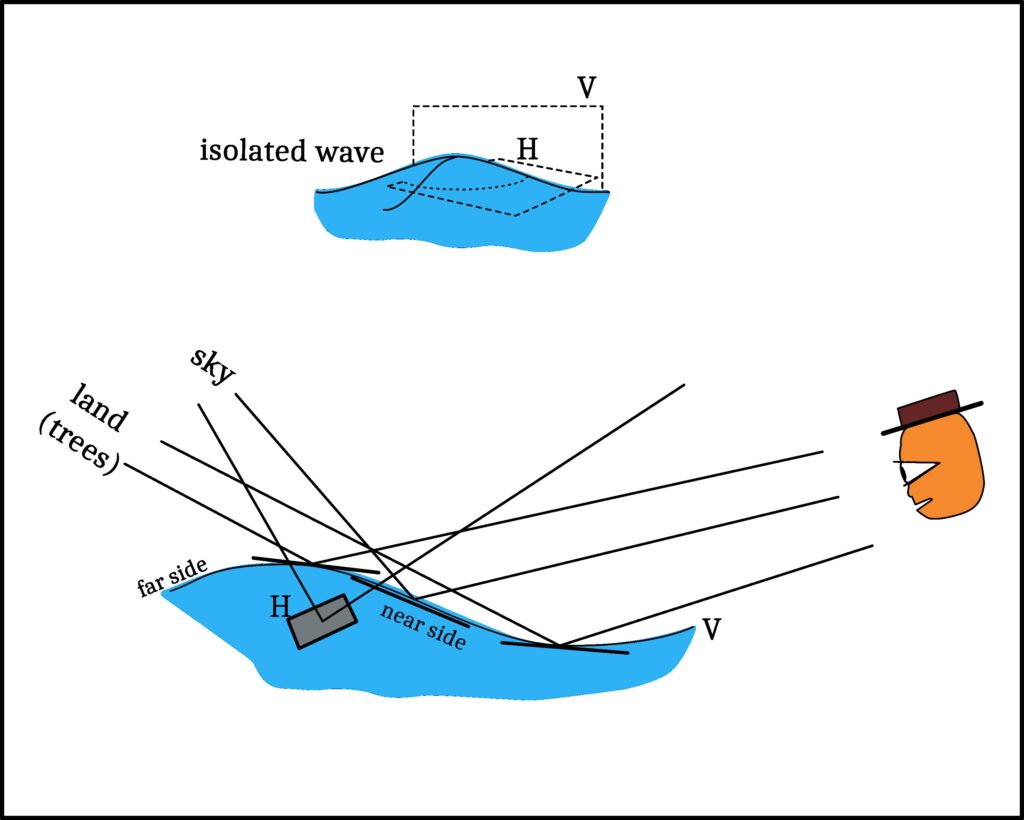
An isolated wave is just a small bump on the water surface, as in the top sketch. We can look at the reflection where the vertical plane “V” cuts the wave and also where the horizontal plane “H” cuts the wave.
The bottom sketch mainly shows the reflections in the vertical V plane. Here we see the top and bottom boundaries of the darker land near the crest and the trough of the wave, respectively, with the brighter sky light coming in at a higher angle in between. So, we see the skypool on the near side of the wave in between these boundaries. The dark boundaries of the skypool occur where the water surface tilts away from us. The three rays going to the man with the stylish hat show the top, middle, and bottom of the skypool. Yet the dark boundaries also occurs to the sides in the “H” plane.
About the sides, the bottom sketch shows one ray from the sky light hitting the side near “H”. This ray reflects away from us, so we don’t see it. Instead, we see darker land to the side (harder to sketch rays in these directions). So, in this simple, idealized wave shape, we can see how the skypool lies within a small patch, and given the smoothness of the wave, it is easy to believe that this patch will be rounded, like an oval. Hence, the skypool.
Not shown is the landpool case. Landpools are similar except they occur on a wave closer to us (the observer), but on the far side of the wave. So, the sketch is similar, except translated a bit and sort-of reversed.
–Jon
*Color and Light in Nature. Cambridge University Press, 1995.