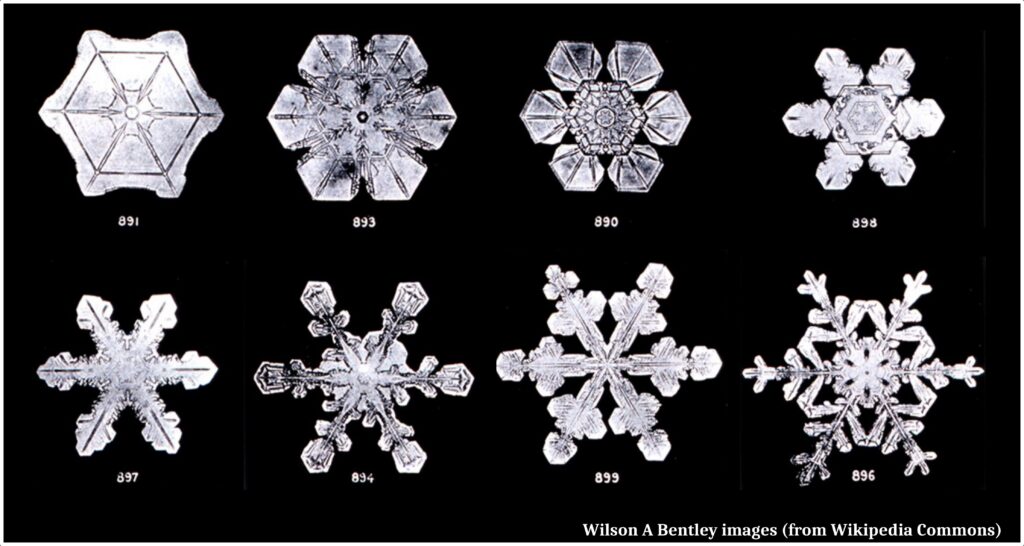
Various versions of this idea been around at least since the 1930s, but I was a little saddened to see it in a recent book* by science journalist Phillip Ball:

The snow crystal (not snowflake**) certainly invites speculations, doesn’t it? So small and pure, yet containing much beauty, variety, and symmetry. It is the detailed symmetry here that provoked the above quote, a symmetry shown both within and amongst the crystal’s six branches. It is striking, certainly, and yet, to someone who has studied snow, the statement is both strange and sad.
Strange? Consider the wording about each branch “knowing”. (Some versions of the statement instead use the word “communicate”. Same deal.) Why should a branch need to know? Isn’t it a general principle in science that, if everything is set up exactly the same in a process or experiment, that we should expect the same result? (If not, then could we even have science? Wait, could we even function?) So, doesn’t it follow that each branch of the snow crystal, if it started from the same situation and grew out into the same environment (natural assumptions), that it too should be the same? Indeed it does. And if each branch grows the same, then obviously it does not need to know what the others do. So, the statement is strangely anti-science. It is also sad because a perfectly good explanation for the symmetry has existed in the literature since the 1970s. As a bonus, part of the explanation is a well-known crystal-growth mechanism that explains a lot more of what we see in snow. Strange and sad. So many missed opportunities leading to unnecessary confusion. But I will correct this sad state right here and now. (Yes! And the world will thank me later (TM).)
The explanation consists of three simple concepts:
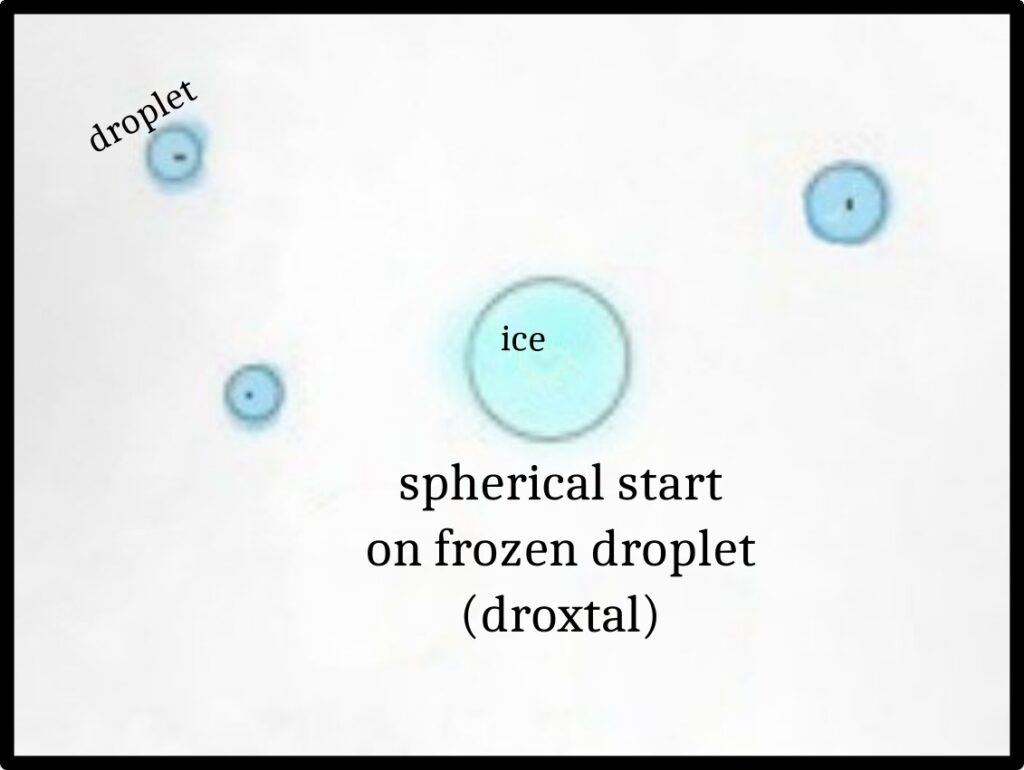
1) Snow crystals, including the above star-shaped ones (starxtals), begin on a frozen drop, which is very symmetric.
2) The surrounding vapor and temperatures are very uniform over distances typical of crystal sizes.
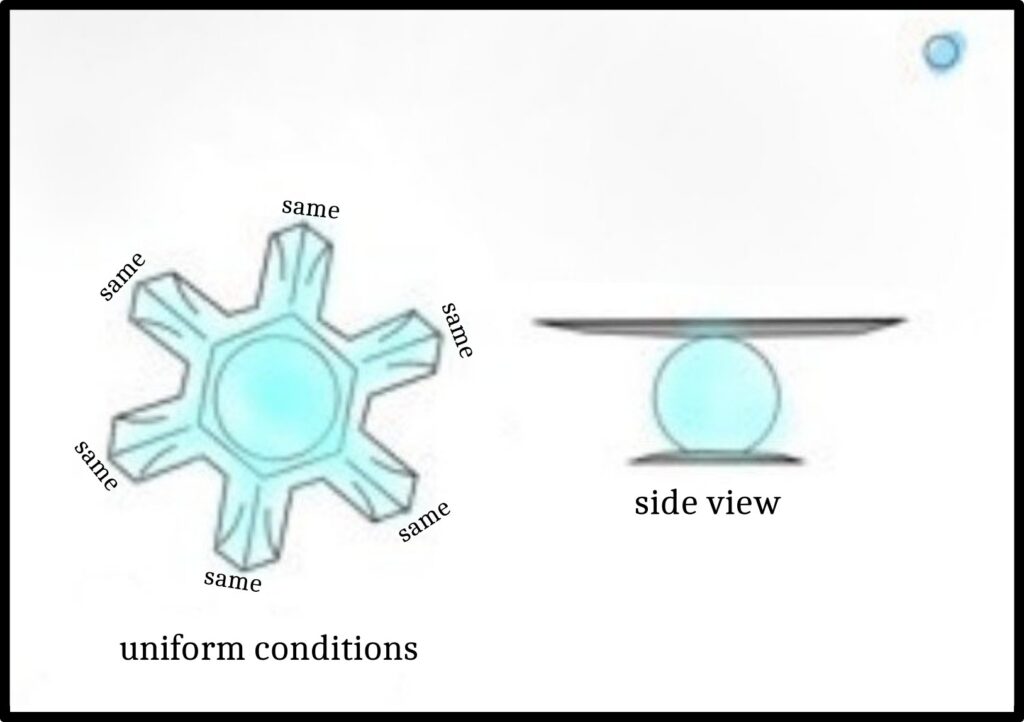
3) Along the crystal perimeter, each crystal face grows by layer nucleation (a crystal-growth mechanism), which depends only on the vapor density and temperature.
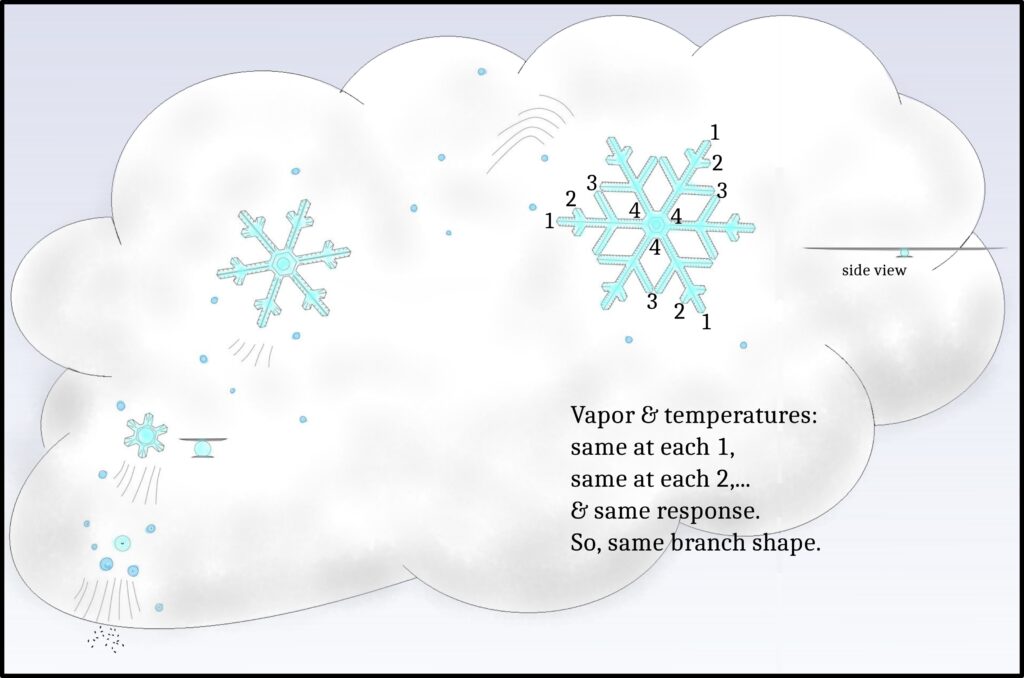
So, the situation for each branch begins the same (1), grows out into the same environment (2), and grows by the same mechanism (3). Hence, each branch grows the same.
Imperfections arise of course. The initial sphere may be somewhat deformed, and the environment of the surrounding vapor will have some non-uniformities, particularly when a droplet passes nearby bringing with it more vapor. Apparently, the imperfections can at times be negligible and we end up with very symmetric crystals. In fact, in most cases, the crystal does experience significant non-uniformities. But these cases are much less likely to be photographed because the photographer is usually looking for the most symmetric cases. Yet even in the most symmetric cases, a close inspection readily shows some differences between the branches.
The most interesting thing here, and what makes the blunders especially sad, is this: Layer nucleation is never mentioned in popular accounts (such as Ball’s) despite it having much explanatory power. This is worth emphasizing.

Layer nucleation’s primary characteristic is its extreme non-linearity+, in which growth is essentially an on-off switch. And this simple characteristic helps to explain not only the symmetry, as above, but also i) the extreme thinness of the starxtals (star-shaped snow crystals, as above), ii) the temperature range in which instead column-shaped crystals form, iii) the intricate nature of crystal branches under some conditions, and iv) the sensitivity of the crystal shape to temperature and humidity leading to the ‘no two alike’ characteristic of each crystal. I point these five features out because they are easily explained without calculation using the on-off characteristic of layer nucleation.
Of course, being the primary growth mechanism of snow crystals, layer nucleation must also be able, in principle, to allow us to understand how most details of the crystal’s shape emerge. There has been progress along this line. But in general, the fine details require some difficult calculations and better experiments to establish. More on layer nucleation in a later post.
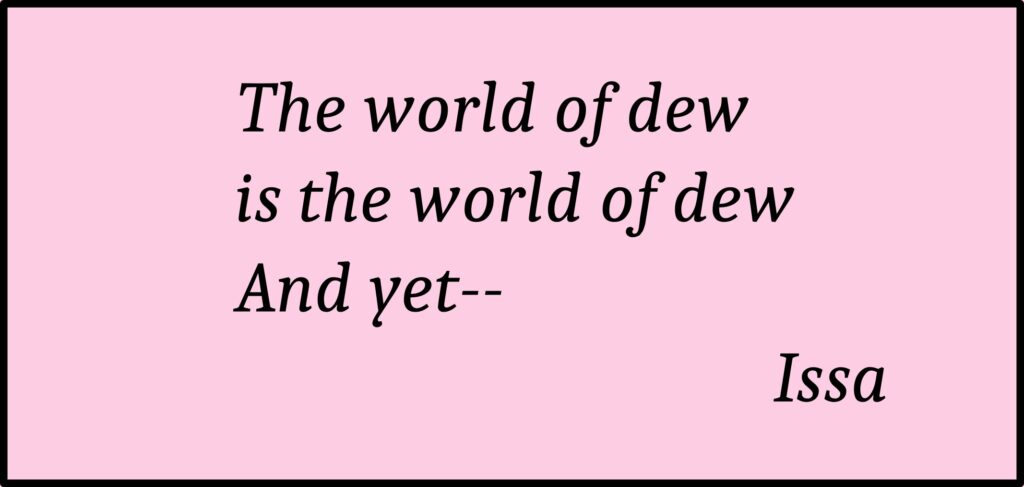
The snow crystal is only a tiny, ephemeral part of our experiences, like the morning dew, and yet there is much it can tell us.
–Jon
* Phillip Ball, with Wenting Zhu and Yan Liang. The Beauty of Chemistry. MIT Press. 2020. 382 pp.
** For well over a hundred years, meteorologists have carefully distinguished aggregates of snow crystals (large clumps) from single snow crystals (often star-shaped). The former are “snowflakes”, the latter are “snow crystals”. Now, is it really that hard to distinguish the two? Do you also have trouble distinguishing a molecule from an atom, a forest from a tree? C’mon. Even Wilson Bentley in the late 1800s was well aware of the distinction. We don’t expect much from a popular science writer, and yet even the popular writer knows the difference between molecules and atoms, forests and trees. Snowfall with snowflakes indicates warm and wet atmospheric conditions, snowfall with snow crystals indicates colder and drier conditions. The distinction is both simple and important.
+ This is a property of nucleation in general. Witness the onset of boiling (nucleation of vapor bubbles) and the sudden formation of a cloud from one’s breath on a cold day (nucleation of droplets). Layer nucleation is the nucleation of new molecular layers on the crystal surface. It has been commented that despite the ubiquitous nature of nucleation in our experiences, it is odd that the first real discussion of it in the popular literature was in a fictional story: Cat’s Cradle by Kurt Vonnegut. I guess that is pretty sad too. Oh well. Or, as Kurt would say “and so it goes”.