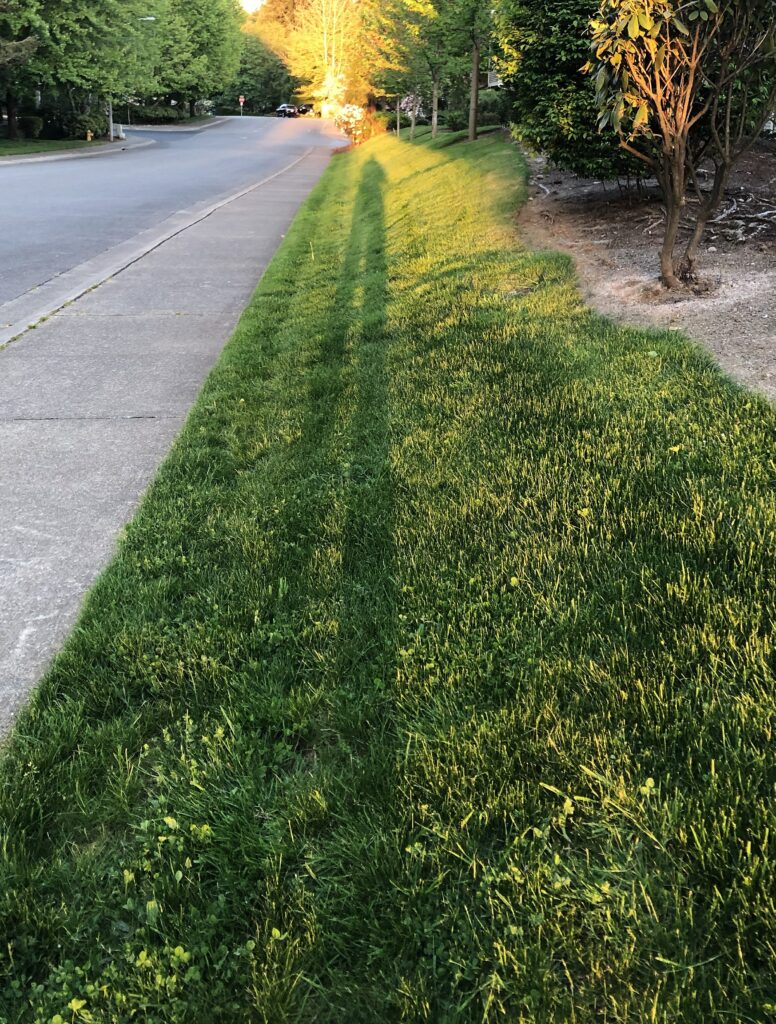
Shadows in the low sun can be amusing. In our shadows, our legs seem to take up most of our bodies, like we are a circus performer on stilts, and our head shrinks to a point. We become pinheads.
In fact, the shadows of our legs look a bit like the parallel railroad tracks that seem to merge at a great distance (the “vanishing point”). Of course, this is all perspective. Another person walking along my shadow would see that each body part had roughly the correct relative proportion relative to my other body parts (i.e., the legs about 4-5 times longer than my head). Ditto for the bird’s view from far above. In fact, my head could be somewhat indistinct due to the increasing fuzziness of shadows at increasing distance. And if the ground is irregular, then weirder distortions can arise.
Minnaert* wrote of some curious folklore about shadows. For instance, anyone possessing a headless shadow would die within a year. The moral of that tale would seem to be telling us to avoid going out in a low sun, unless the pinhead shadows are exempt.
Look again at my shadow on grass above and notice something else: It is brighter in the grass near my head. Why is that? In this case, there are two effects. One is some shadow casting from trees behind and beside me, making the background brighter in the distance. But there is another effect you can see right in the grass itself: shadow hiding or the opposition effect. The point near my head shadow is called the anti-solar point because it is exactly opposite the sun from the camera. In this direction, the camera “sees” no shadows from the grass because the shadows are effectively hiding behind each blade of grass. Look at the grass in the foreground and you can see all the dark shadows from the grass itself. It is like the dark rectangles sitting behind the white rectangles of the same size in the sketch below (the black represents the shadow of the white):
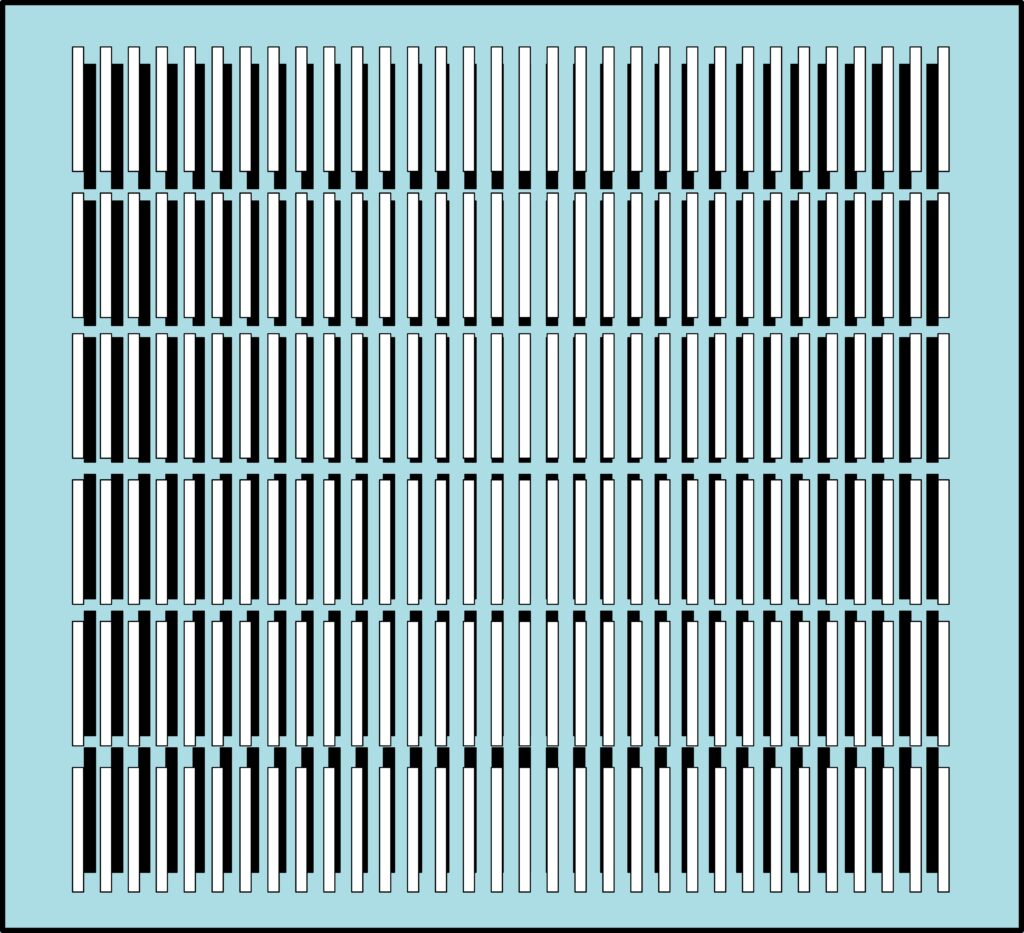
In the above, looking away from the center is the same as looking to the side or foreground in the top photograph: one can see the shadows there. So, it is darker away from the center, just like it is darker away from the anti-solar point. The opposition effect.
And if you are in the pondering mood, you might also ask yourself why the brightest grass near my head’s shadow is so yellow. Why not brighter green?
–Jon
*M. Minnaert, The Nature of Light & Colour in the Open Air. Dover. Often cited here.