
What a way to fly, eh?
You are really tiny, sitting on a leaf’s edge. A light breeze rises up, so you let out some line. The tugging on the line tells you the conditions are good, so you let out more line. Next thing you know, you’re airborne. To go up faster, you let out even more line, to descend, you take some in. Like a balloonist, controlling your direction requires great skill, with some directions simply impossible to go. At the mercy of the winds, yet oh so free.
The above, I think, is roughly how spiders fly. Though I would very much like to know more about how they do it, my focus here is on how to observe them.
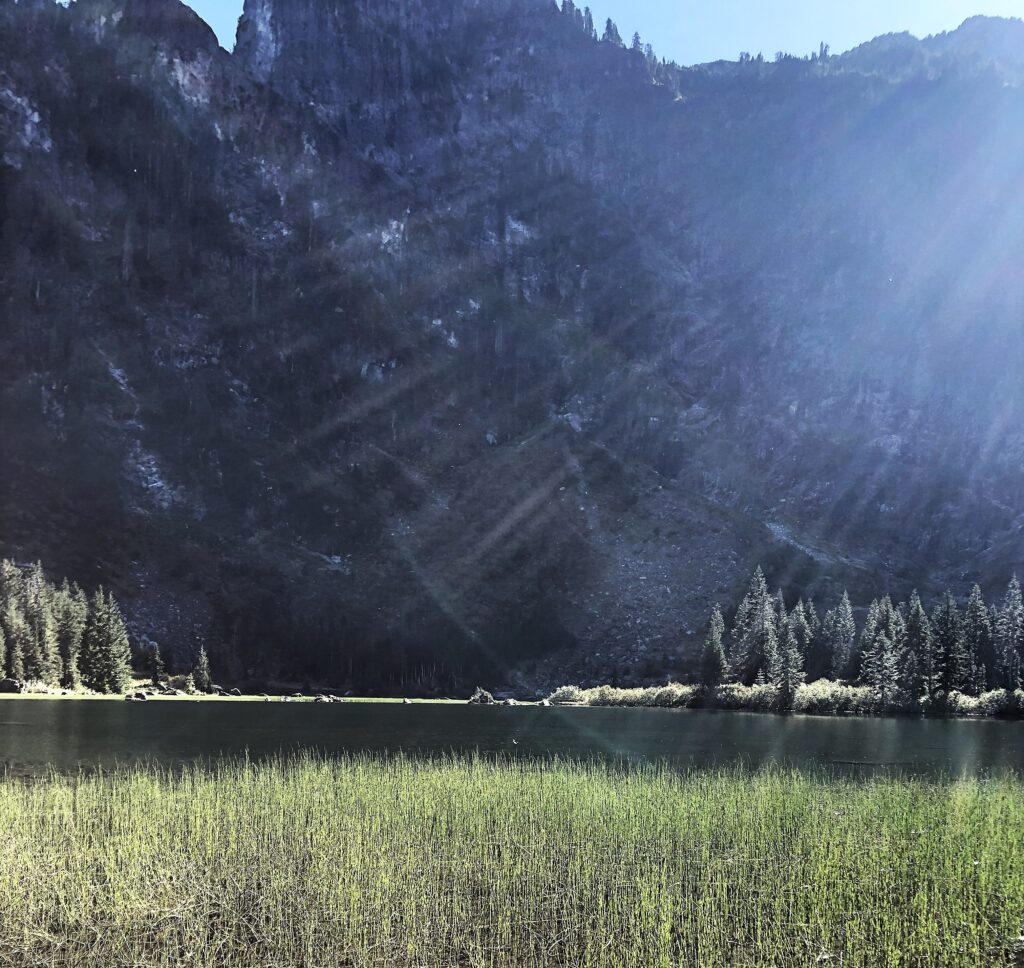
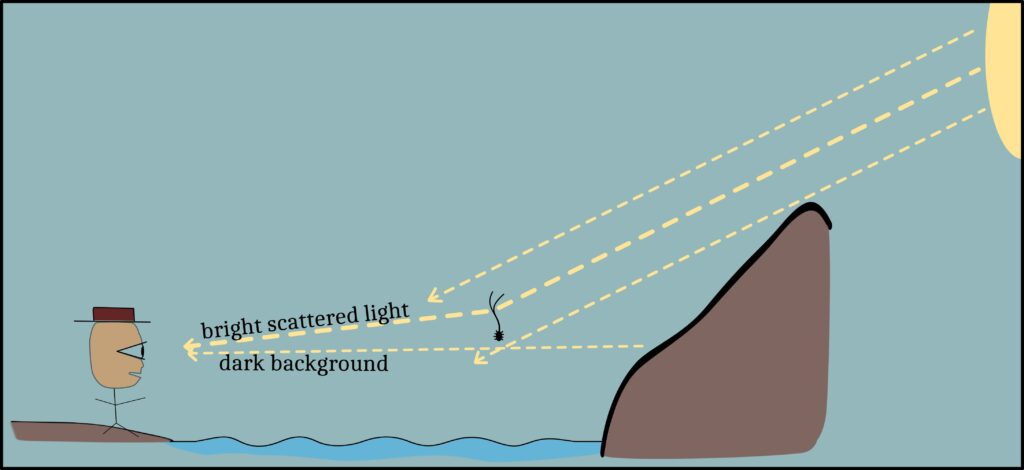
Despite knowing about the phenomena, I was amazed by what I saw one day on a hike with Sam up to Heather Lake in the Washington Cascades (photo above). The lake sits in a depression surrounded on three sides by high ridges and mountains. Upon arriving, the sun was just slightly over the mountains on the south side, putting us and the lake in sunshine while keeping the background mountains dark. Such a situation is ideal for seeing even microscopic items drifting over the lake including many spider threads. Why? Because a lot of light glances (scatters) off the tiny object and into your eye, while the background cannot overwhelm the object because it is dark.
The physicist refers to light “scattering”, which is distinct, though similar, to reflecting: light hits an object, and some comes off in various directions. For the molecules in our atmosphere, the scattering is the same in the forward and backward directions (top sketch below), but the amount scattered depends on the wavelength. For these small sizes, the smallest wavelengths of violet and blue scatter the most, and so we mostly see blue air in the sky (our eyes are not as sensitive to violet). For larger particles, such as spider webs and droplets, the amount of light scattered is much stronger in the forward direction, as if the light just “glances” off the object, but is the same for all wavelengths (see bottom examples below), making the object white.
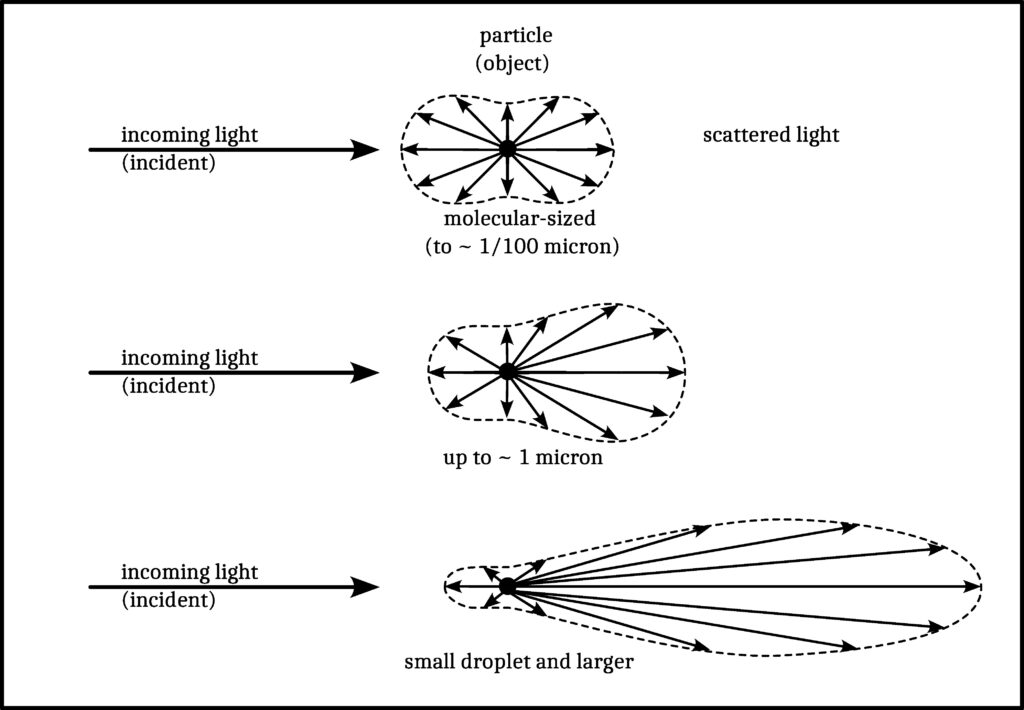
(Diagram above based on Minnaert, Light and Colour in the Open Air)
Pretty much all objects are observed via scattered light (unless the object itself is a light source, e.g., computer monitors, lightning, fire). Some light continues going forward, though at a different angle as the incident, and some goes back. As a simple comparison of forward vs backward, try this observation. While driving in the early morning or late evening (i.e., a low sun), compare the brightness of the road ahead to the road in the rear-view mirror. If you are driving towards a low sun, the road is much brighter in front than rear, and the reverse if you are driving away. (See the sketch below.) Note that this is not the direct light, which you should be blocking with the visor, but the forward-scattered light off the road.
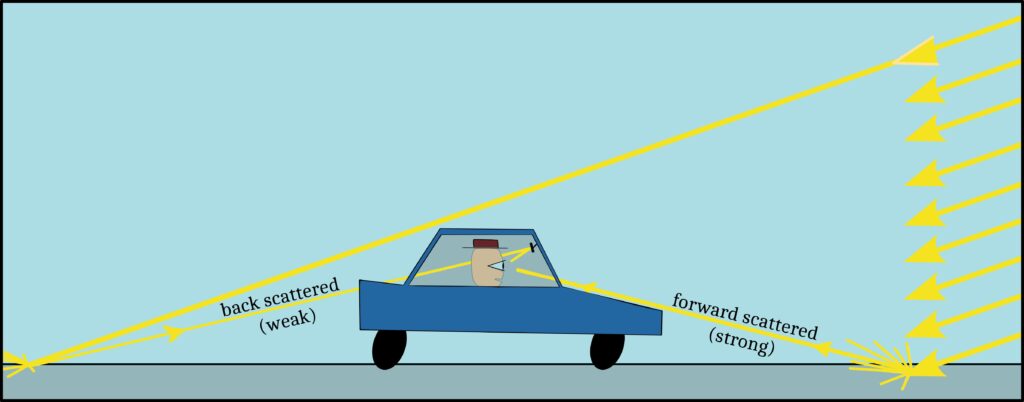
This brightness of forward scattering is also why driving into the sun makes it hard to see through the windshield even if your visor blocks the sun from your eyes. The light forward-scatters off small particles and tiny micro-scratches on the windshield. Keep that windshield clean on both sides!
Back by the lake, we could block off the direct sun with our hands to see the relatively bright forward-scattering off the spider webs against the dark background. Such a situation is ideal for viewing small particles. Unfortunately, my pictures did not show all the webs that I saw, which is due to my poor photography skills. I will be back sometime and make a greater effort.
A similar situation also gave me an “aha!” moment during the pandemic. I recall one day, early in 2020, driving with friends to the mountains. As I was talking, we drove into a spot where the sun shown in brightly on my breath, the sun blocked from my eyes by the visor, and the background of mountain forest quite dark. Ideal conditions for seeing forward-scattered light. And to my shock, I could see small droplets that had just flown out of my breath! Now I am not one to spit while talking, so this was certainly unexpected. (And also, an indication that, if sick, I should wear a mask to prevent emitting germs in those breath-droplets. Germs in droplets can be trapped by a mask because droplets are large. But once the droplet evaporates, the tiny isolated germ can easily slip past.) Even regular speech, soft and smooth, emits droplets. You may like to think that a refined, reserved, sophisticated person as yourself as an exception, but sorry, it is true for you too.
You often see the strong forward-scattering effect in movies. Our protagonist is hiding inside a dark hut or room of some sort, and then something opens up in the wall and a bright shaft of light comes through. You see this beam or shaft of white. It reveals all kinds of dust in the air– air that probably would have seemed quite clean under normal lighting. In fact, without the dust, you cannot see the light.
— Jon