
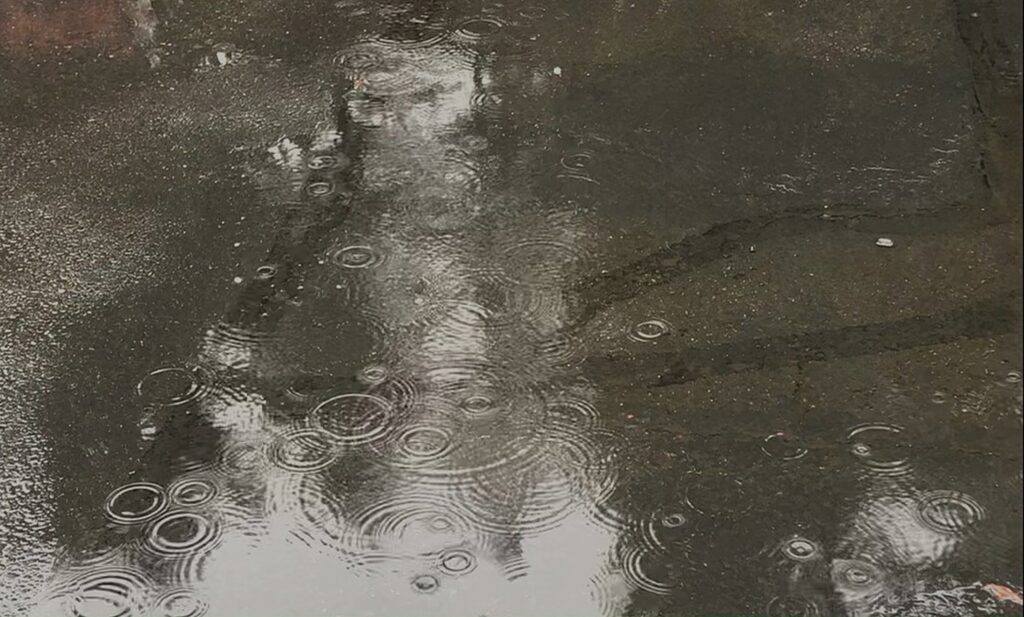
A common sight here in the Seattle area: puddles in the rain. A drop hits, then a circular wavelet expands outward. When watching this happen, I tend to just see larger wavelet rings, never noticing the small initial waves. Do the waves start out very fast, then slow down as they get larger?
The picture above shows a full range of wavelet diameters, with many of small sizes. If they moved particularly fast when small, then there should be almost no small-diameter wavelets in the picture. Strike one against the small=fast theory. Another strike against this theory: when I slowed down my video of the wavelets, there was no noticeable change in speed as the wavelets expanded.
So, I attribute my observation of mainly noticing larger wavelet rings to simply not having my eye focused on the spot where and when a raindrop hits. Other than not looking at the right spot, it is also trivially true that smaller things are harder to see. Instead, one’s eye catches the relatively obvious larger wavelet rings, diverting one’s attention to these easier-to-notice cases, thus missing the smaller ones. It all happens too fast and unexpectedly.
Call it the “apple drop effect”. You go out to an orchard and see apples on the ground and on the tree. You know they drop down to the ground, but have you ever seen an apple fall? You might think yes, obviously, that is easy. But I challenge you to stand in an orchard when the apples are falling and see if you can actually see one fall. I tried this a few times when I was working in a laboratory in which the guest house was in an apple orchard*. Sometimes I would catch the apple bounce, and sometimes I would see a branch recoil, but never did I see an apple in flight. It is too fast. Of course, if you hold an apple at branch height and drop it, you’ll see it because you know where to look. It is a completely different story when you don’t know exactly where to look. Try it sometime.
— Jon
*Sort of like Isaac Newton, eh? In fact, the story of Newton first spurred my attempt at observation. Did Newton see falling apples? Who knows. In an early, classic biography of Newton, the biographer merely quotes him as saying he made his gravity insight while “sitting in a contemplative mood occasion’d by the fall of an apple.” From this I think science writers ran with it, claiming that an apple landed on Newton’s head, but for all we know, he just heard the occasional plop in the background.