

It seems like it should be a law of nature: reflections of a source cannot be brighter than the source itself. How could it be otherwise? To be otherwise would imply that the object somehow amplifies the light, which is impossible. And yet, there are situations that seem to bend this obvious “law”.
If you look at a reflection in a still puddle, pond, or lake, one so still that the reflection is essentially just as sharp as the direct scene, you will find the reflected scene darker. Indeed, in a photograph, viewers often prefer this reflected scene over the direct because the direct one is too bright. The reflection is darker because some of the incident light penetrates and is absorbed below the surface. So, it all makes complete sense, and the above “law” seems perfectly justified theoretically.
Now look again at the top image. Dark clouds are reflected in the rippled lake below. Their image is not sharp, yet it is still clear that these are reflections. But they are … less dark. Or, is it an optical illusion? To see that it is not, look at the same photo below in which I copied and pasted parts of the cloud above to be next to their reflections. The direct images are indeed darker. How can this be?
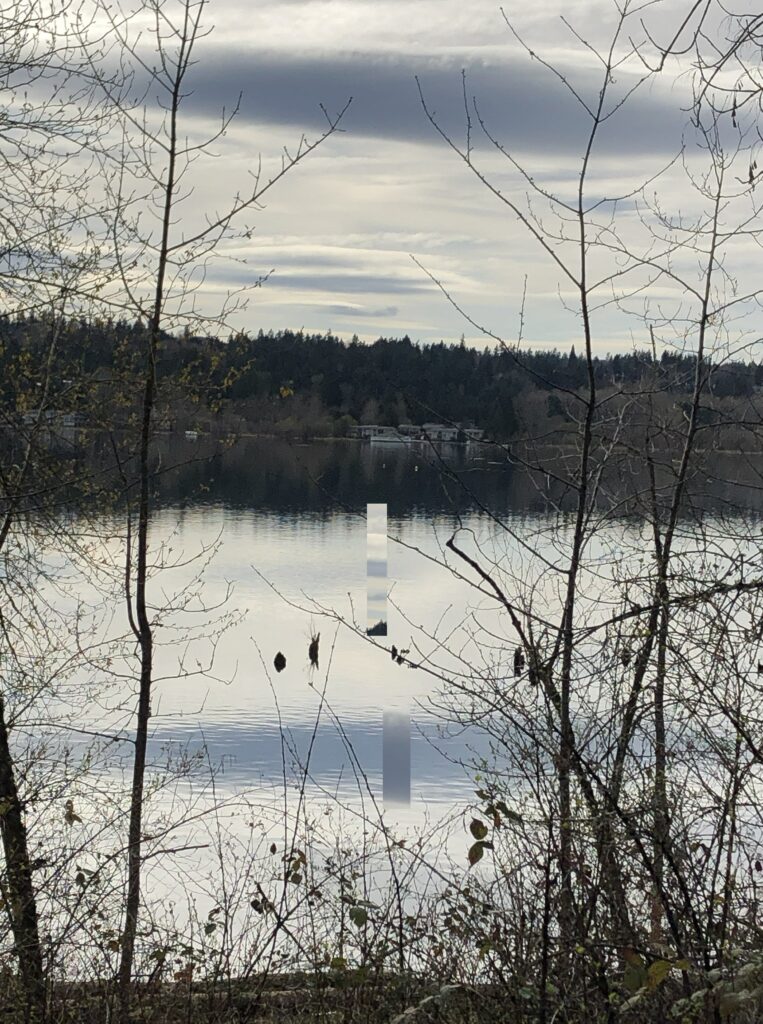
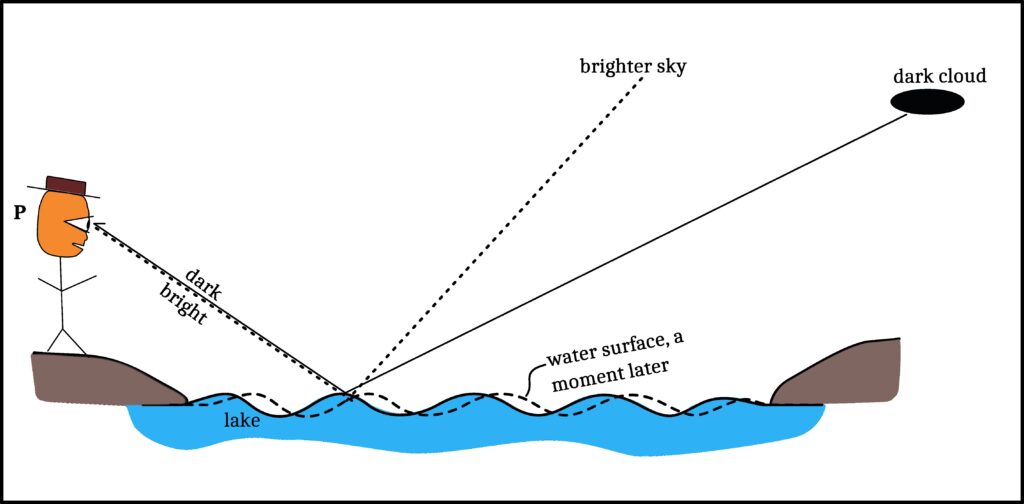
It can only be that the reflected image has blended various reflections together, reflections from both the dark cloud and the nearby brighter sky. I don’t know of an easy way to directly test this explanation (except, see below), so I will just put it out there and look for supporting evidence later.
This effect reminds me of an article by Craig Bohren about a similar case. One day out in the snow, he noticed how the white snow appeared brighter than the grey sky above. Yet it was largely an illusion. In comparing snow and sky at the same time, he had to be looking in the distance where the snow appears near the horizon. But this view shows only the distant sky, which is darker (around midday) than the overhead sky. Yet it was the overhead sky that was contributing the most incident light on the snow. And it was mainly this brighter overhead light that is scattered back to his eye. So, in this case, he was not making a direct comparison between the main source of light and its scattered light. To demonstrate, he placed a mirror in the snow, pointed up to reflect the overhead sky. Then, the comparison between snow and sky image revealed that the snow was indeed darker than the sky above.
In fact, the same experiment had been discussed much earlier by Minnaert*. In section 94 of his book, he states “If you take a little mirror and place it in such a way that the image of the sky is seen next to that of the snow, you will notice that the snow is indeed grey in comparison with the white sky. Be sure to carry out this experiment; it is as convincing as it is surprising!” Minnaert goes on to add “And yet the illusion of the contrast is not destroyed, though we know that in reality it is the other way round.” In other words, even though we know the snow to be darker, we are still fooled.
To do a similar experiment for the cloud image on the lake case, one could make a vessel that could be partly submerged in the lake, such that its sides prevented any waves from entering, and float it out into the middle of the lake. Then, one could make a direct comparison between the image from the rippled water and that from the mirror-smooth water. I probably won’t ever make that experiment. But perhaps someday, on some walk I might discover two large puddles, side-by-side in which one has some sort of ripple-making agitation, the other none. A comparison of reflected images in both would be instructive.
— Jon
*The Nature of Light and Colour in the Open Air, Dover books, as I often cite here. See section 94 “White snow and Grey Sky”.
Dear Jon, very interesting observations.
Reminds me of the saying,” The Perception is the Reality”.
Our 5 senses of perception are fallible. And our sense of Reality too then must be.
Thanks Sujay, interesting thought.
We are so easily fooled by our senses that we must also be fooled by nature itself. The philosophers must surely agree. Yet still, very fun to try to figure things out.