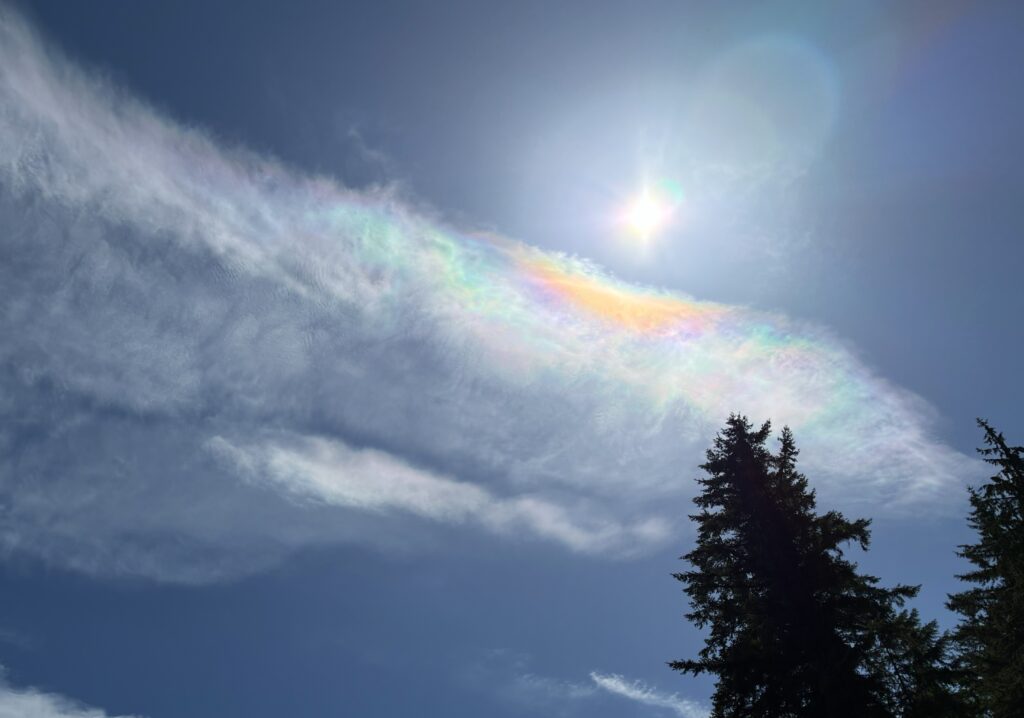
In general, it is dangerous to look close to the sun, but if you are careful, you may be rewarded. Example: the corona. The corona shows vivid colors at the price of being close (in angle) to the dazzling sun. It is essentially the same phenomena as cloud iridescence, a topic I described a few months back: both are due to diffraction of light around tiny droplets in the clouds. The corona is just the case when you can see how the colors are making rings around the sun.
Corona and iridescence are more common in higher, colder clouds, such as altostratus, partly because these clouds, by being colder and having less vertical updrafts, tend to have smaller droplets that maintain a uniform and constant size.
If the droplets were all the same size, and completely covered the sky, then the corona would be a series of colored circles around the sun. At night, one can often see a relatively plain corona around the moon when it is behind a thin cloud. In this case, the ring is mostly white with a red outer edge. The innermost white part is called the aureole. In the above picture, you can see part of this first red edge. Beyond that blue, green, and some yellow. There are other patches of green indicating that the droplets are not uniformly sized. If this were completely uniform and covered more of the sky, a new band of colored rings would continue the pattern. I believe up to three bands have been observed in nature. Often, one can see two. But beware of looking directly at the sun.
–Jon