
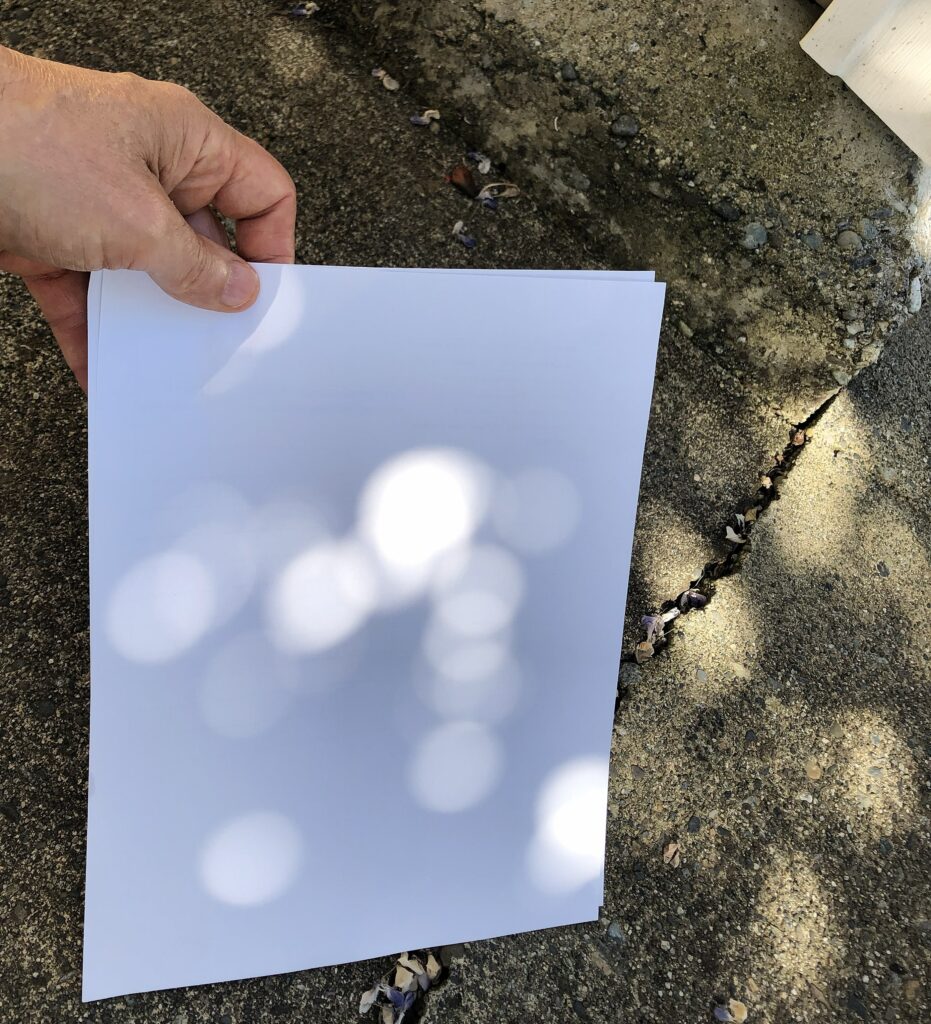
Outdoor images of the sun, from sunlight through small apertures in the foliage, also go by the name “sun pictures”. They are actually inverted images of the sun, just like images from a pinhole camera are inverted. I described them in the April 30 post (https://wonderintheair.com/shadows-from-fences-also-sun-pictures/ ). The above picture shows images arising from gaps in some wisteria foliage. With a sheet of white paper, I made a small screen that was oriented orthogonal to the incident rays of light, and the result clearly shows circular images.
Q: Why circular? Because the sun’s disc is circular and the holes act as an inversion point for the rays from different parts of the sun’s disc.
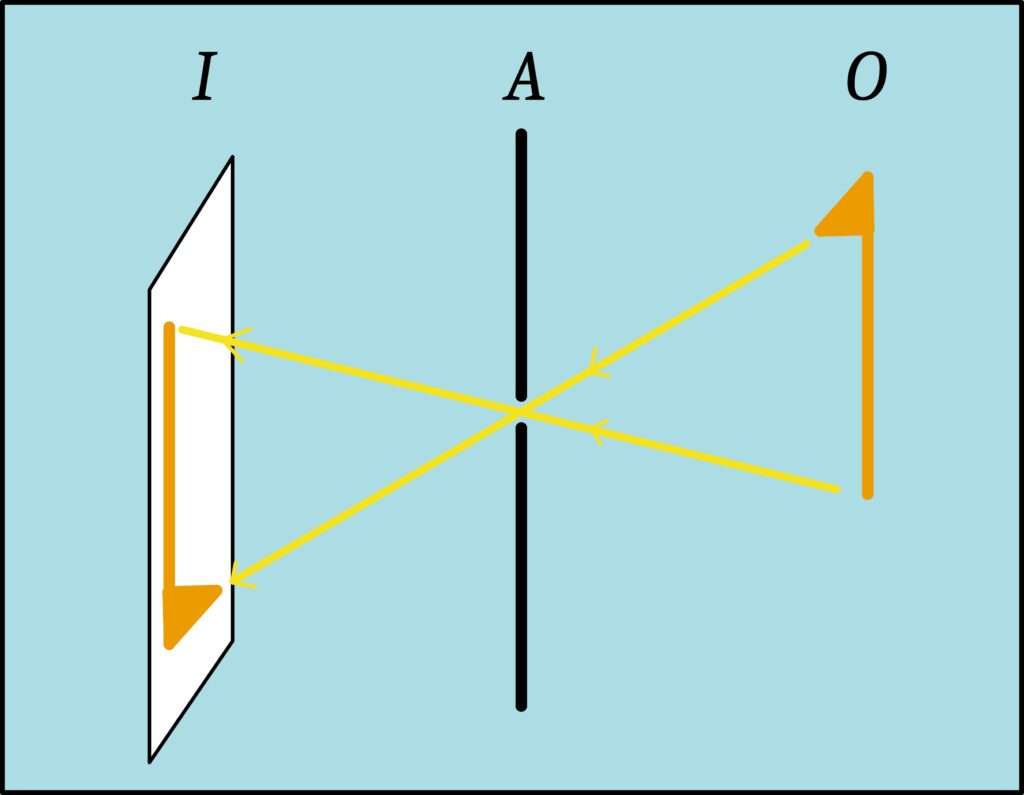
In the sketch above, the light from the flag’s end at O goes through the hole at A and lights up the image screen at I. This is the only path through the hole, so the flag end’s light only goes one place. Ditto for the base of the flagpole, except it end up above the flag on the image screen at I. That is, the flag’s image is inverted from the original at O.
Q: Why are the circles all nearly the same size? Because the apertures in the trellis are all at nearly the same distance from the white paper. If there was another trellis twice as high, the circles would be twice as big. In the diagram above, imagine moving the image plane further back to the left (and away from the hole at A). You can see how the size of the image would increase. And if you had a bunch of holes in the same plane A, then you would have a bunch of identical images on the screen at I.
Q: Why are some circles brighter, some lighter? Because the holes are not all the same size. The smallest holes make the sharpest images, but are fainter because they let less light through. The larger holes are brighter because they let more light through, but are not as sharp because the light inverts around a wider area of points in the aperture.
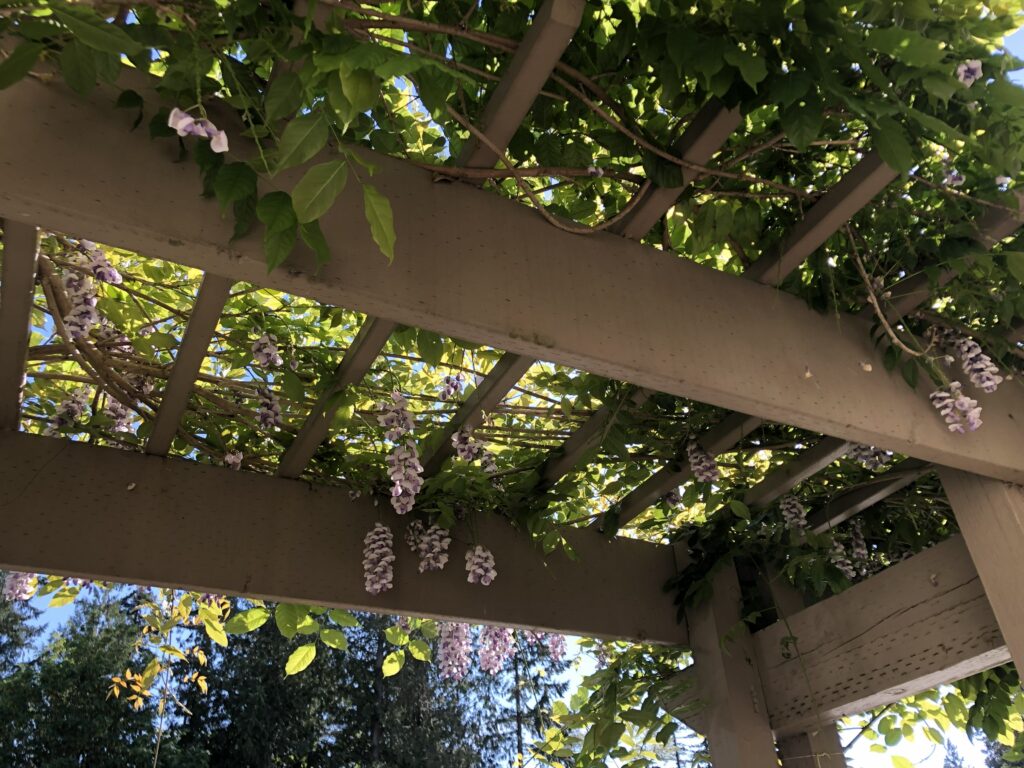
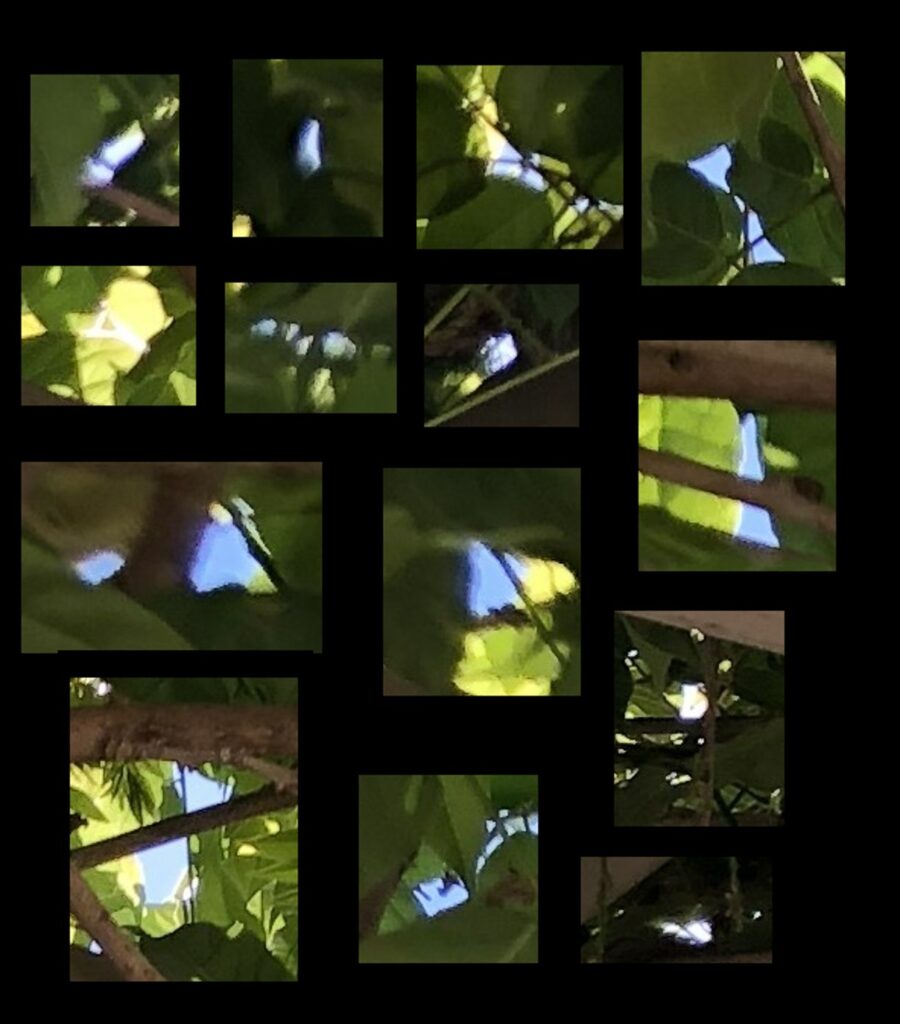
What do the apertures (foliage gaps for the light) look like? Here is the trellis and wisteria. You can see some small holes between the leaves and other things. These holes are probably not the same as the ones for the sun picture because we are not looking back directly at the sun, yet should be similar. A close up below shows some of their variety and irregular, somewhat polygonal, shapes.
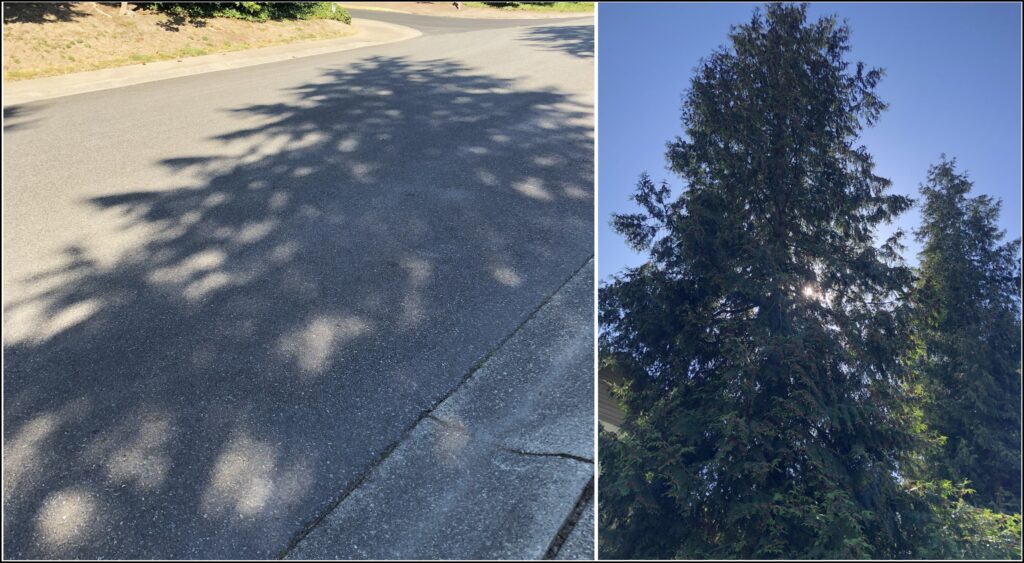
Often, the images come from much higher places, such as the case with the conifers below. Left, the sun pictures in the shadow, right, the source of the shadow and apertures for the sun pictures.
Something to look at.
–Jon