
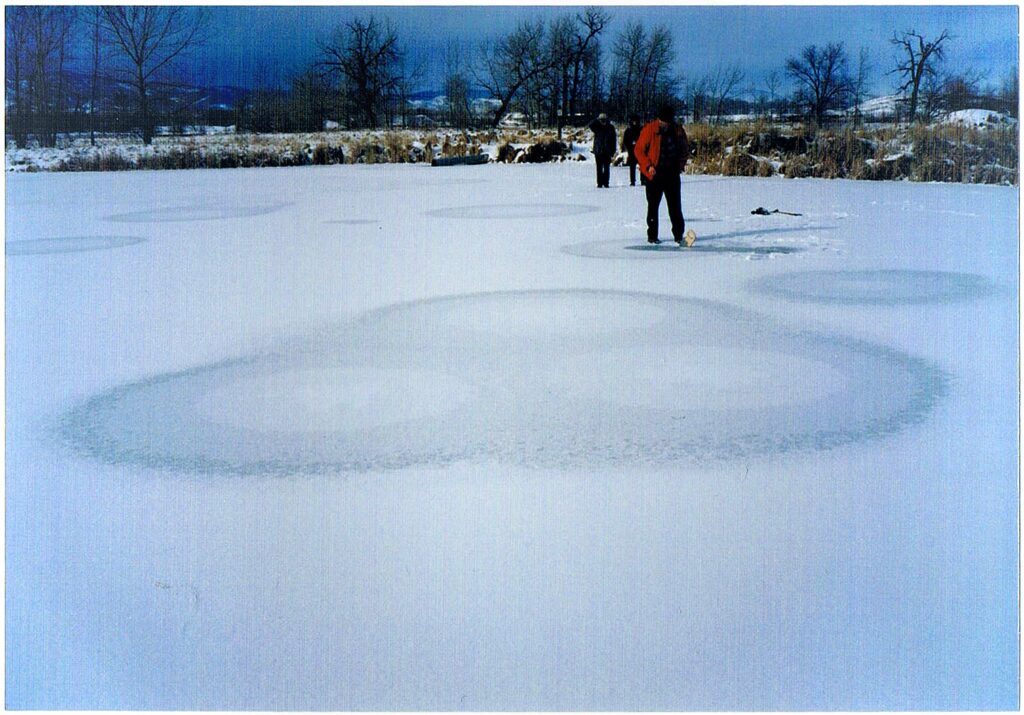
WITA’s new feature: science blunders often seen in popular works.
I’ve seen this particular one twice recently from writers who I expected to be much more careful. It’s one of those “facts” folks believe was proven long ago and now is just passed along without thinking. Here is one version typical of others*:

This statement is about water’s expansion and where lakes freeze. Let’s examine it from a few angles. 1) Is it true as stated? 2) What exactly would happen in a lake if ice instead sank in water? and 3) Why does ice freeze on top of lakes (and other large bodies of water)? Let me start with 3) because it introduces some practical ideas.
First, some relevant scientific principles:
- Pure water at atmospheric pressure freezes if it is below 0 C (32 F) and is adjacent to already formed ice. That is, if ice is present, and the water is cold enough, the ice will grow as more water freezes.
- If no ice is present and the conditions are suitable (see A), the water will freeze only where a suitable “seed” is present that helps the ice get started. (This is called heterogeneous nucleation.)
When neither ice nor an ice seed are present, there is still a way for ice to form, but it requires extremely cold conditions**.
#3) Now the answer to 3) above is that the body of water in nature (e.g., lake) freezes at the top because of A and B above. (Note the lack of “expansion” or floating mentioned in A or B.) The top surface of the water is coldest, and hence reaches 0 C first. Also, either ice (from shore) or a seed starts the ice. The ice appears at the top of the water for a few reasons, one of which is that the shoreline land tends to reach freezing temperatures before the water and thus usually has ice before the water, meaning that the ice grows out from the shore, firmly attached to the ice on land. The rigid attachment helps keep the ice on top. Further from shore, the ice’s floatation helps keep it on top of the water, but ice near land would form from the top regardless. In short: ice forms at the top regardless of whether or not water expands upon freezing. Why? Because it is coldest there.
And why is the top of the land and top of the water the coldest spots? The temperature of anything, land or water, depends on the strengths of its various heat sources and sinks. For instance, the land cools when a source of heat decreases or a heat sink increases. Usually, it is a decrease from solar radiation (sunshine) that drives the cooling, though other sources are important too. When this happens, as during fall and winter in the northern hemisphere, the ground cools down from the top, radiating and conducting heat to the atmosphere above. It is much like us cooling from our skin when we step out of a warm building into a cool night. Our exposed skin is the coldest parts of our bodies. What are all the heat sources? The sketch below shows them for land and water, including conduction (heat flow from contact), latent heat (such as the cooling one feels on the skin when water evaporates), and convection-mixing. All sources of heat flow can be important in some situations, so exact predictions of temperature are very difficult. Also, all but the solar radiation can go either direction. Sorry, but nature is complex.
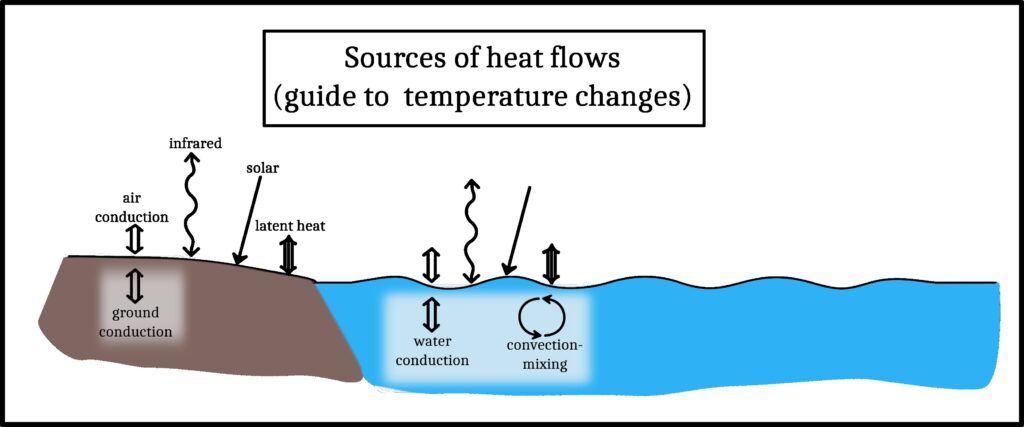
The cooling of bodies of water is similar to that of land, except it has an additional heat flow. Like the land, the water cools from the top, so naturally, we should expect the top layer of water to be significantly cooler than deep water, at least during the cooling times of the year. But this is not always the case because water, unlike soil, is free to move according to any changes in forces. As the top surface cools (say, during the approach of winter), the water there becomes more dense, making it sink. So, instead of just the top surface cooling down, what actually happens is that the entire depth of water gets mixed as the cooled water sinks, meaning that the entire depth of water cools as a single, massive unit of roughly uniform temperature. In the sketch above, this is the “convection-mixing”. And as you know, the more massive an object, the slower it can change its temperature. So, compared to land, and as our experience tells us, the water takes longer to cool in the winter and longer to warm in the summer.
But water has a curious property: When water cools below 4 C (~39 F), it begins to get less dense and stays at the top. No more sinking, no more mixing. The convection-mixing stops in the top surface layer. See sketch below.
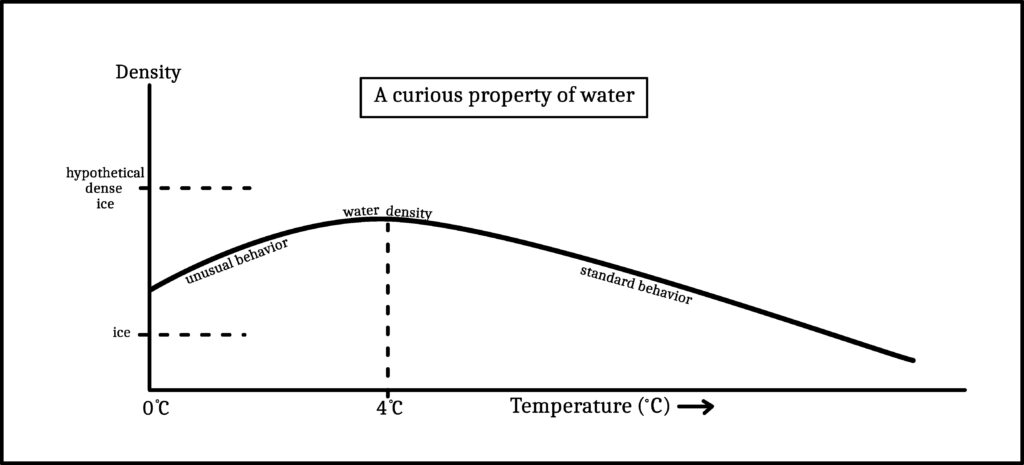
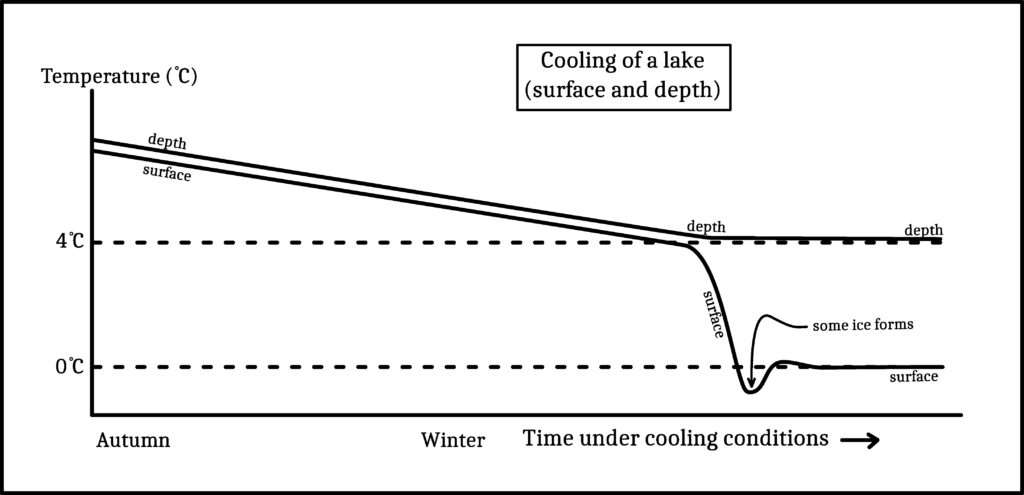
For the lake, this is huge. It means that once the temperature of the top layer of water gets below 4 C, it can cool relatively quickly because the cooler water stays at the top. Water at depth stays near 4 C, not cooling. See, in the plot below, how the temperatures of the surface and depth are the same as the body of water slowly cools, but once that temperature reaches 4 C, the surface water at the top starts to cool much faster while the rest of the water depth remains at 4 C. So, the water first reaches the freezing point of 0 C (32 F) at the top. Thus, water bodies in nature freeze at the top.
#2) About question 2), what would happen if instead ice sank in water? This is very hard to answer with complete confidence because nature is always surprising and complex. As a rough guess, I would think that ice would, as before, generally start from shore and grow along the top because, as before, the temperature is coldest there. However, there would not be the thin layers of ice that spread out over the interior of ponds and lakes because there would be no buoyancy to hold up the ice. Ice that formed away from shore, for example, from snowfall, or some seed of material that nucleates ice, would not grow by much before sinking down and melting. The melt, being colder than the surrounding water, would rise up to the surface. So, the surface layer would cool as before, and the water below the 4 C line would remain relatively uniform in temperature. This water would cool very slowly because the depth below the 4 C line would still act as one large mass. So, because the cooling is at top, it would take a very long time for the entire depth of water to reach 0 C whether or not the ice floats or sinks***. Without a layer of ice on top, I think this cooling could be slightly faster (because water evaporates faster than ice there is more latent-heat cooling), but probably not significantly so (ice also conducts heat faster than water, making the ice-free surface cool slower). Thus, I would suppose the fish would continue much as before, but if some changes (e.g., thicker ice near shore) forced them to change their habits then they would figure it out, either on an individual basis or via evolution.
What would happen once the entire depth reaches 0 C? At this point ice forming on top can sink to the bottom and stay there. Though ice could build up from the bottom this way, it is not freezing at the bottom. As before, it is still freezing at the top because the water is still cooling at the top+.
#1) So, based on the answers to #2 and #3, the answer to #1 is likely false. At least I can say that anyone making the claim probably cannot back it up. And the fish at least should make it through due to the very slow cooling at depth. Moreover, it would seem hard to prove that, with all the cooling at the top, the bottom could ever freeze first. I’m not saying it is impossible, for nature always seems to have a trick up its sleeve, it is just far from obvious.
It would be another interesting case to consider what would happen if water did not have a density maximum at 4 C. Feel free to enjoy that puzzle—I will pass on it for now++.
–Jon
*Martin Gardner, The Whys of a Philosophical Scrivener. St. Martin’s Griffin, NY 1999. See page 200. Otherwise, excellent book. His mistake here has no bearing on his arguments. (He is arguing that we live in a special place here on Earth, and if conditions were much different, we wouldn’t exist.)
The other location I saw the blunder was on a recent science article published online (April 2026) by a science journalist. The journal itself is reputable and better than about 99% of the science writings I see online, yet you will still regularly find blunders there.
**Pure water can freeze without a seed and without ice present if the temperature goes below -40 C (also -40 F). Such freezing is called homogeneous nucleation and can occur in the atmosphere, but is not a factor in the large bodies of water we are considering here.
***Consider the case of a river. Ever hear of a deep river ever freezing completely solid? Probably not. Like the case with the water depth below 4 C, the water in a river is continually mixed. Because it is well-mixed, the entire body must reach 0 C before freezing, and as I asked above, ever hear of this happening? It just takes too long. Our winters are too short and too warm. (This argument is simplified, as the river water, when still near the source, is relatively warm having just come out of the ground.)
+ By the way, you can make a container of water freeze from the bottom. I am not referring now to a lake or pond, but an artificial container. How? Try cooling the water from the bottom. But of course, even a simple case can reveal unexpected results thanks to the curious property of water.
++The density maximum is actually related to the floating of ice, at least according to one theory. In this theory, as the water cools, the water molecules make fleeting ice-like structures with increasing regularity. As the water gains more ice-like structure, its density approaches (yet never reaches) that of ice, which is less dense. Below 4 C, this effect starts to dominate the density trend.