
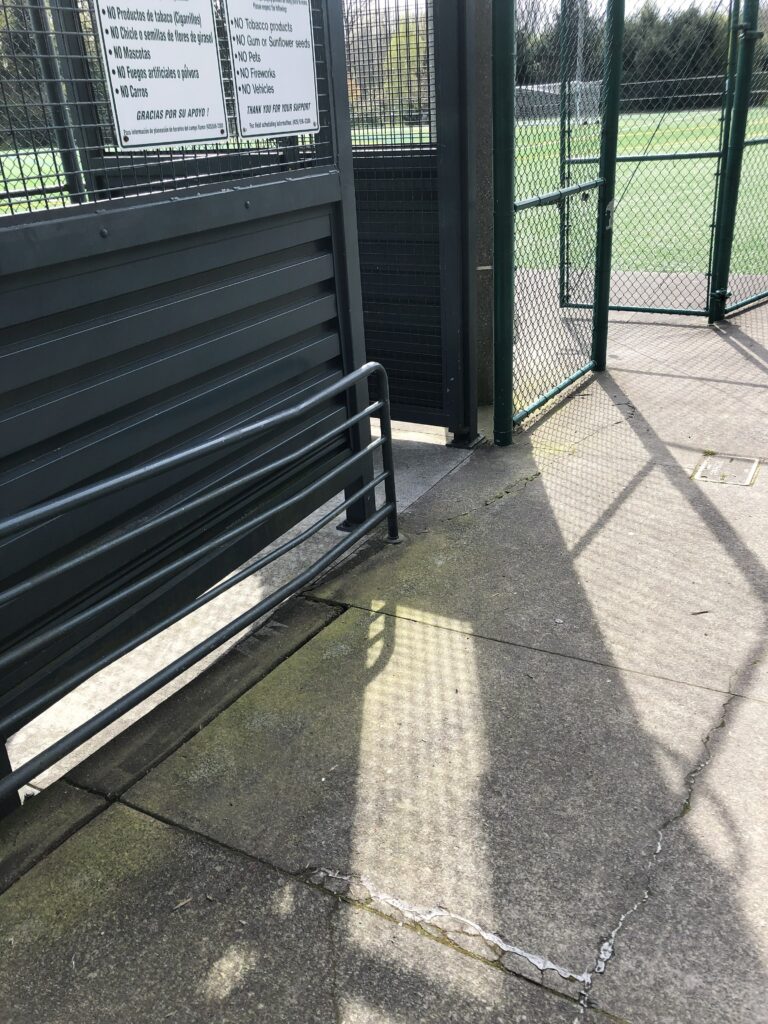
Shadows on sunny days are everywhere, yet rarely given much thought.
Minnaert* makes some interesting observations about shadows that you can readily make yourself, particularly when the sun is low in the sky. Consider shadows from fences, particularly the types made with thick wires running in two directions. Chain-link fences are a common example, and you can find these all over town. On a sunny day, when walking by such a fence, ever notice how the shadow of one set of wires can overwhelm the other?
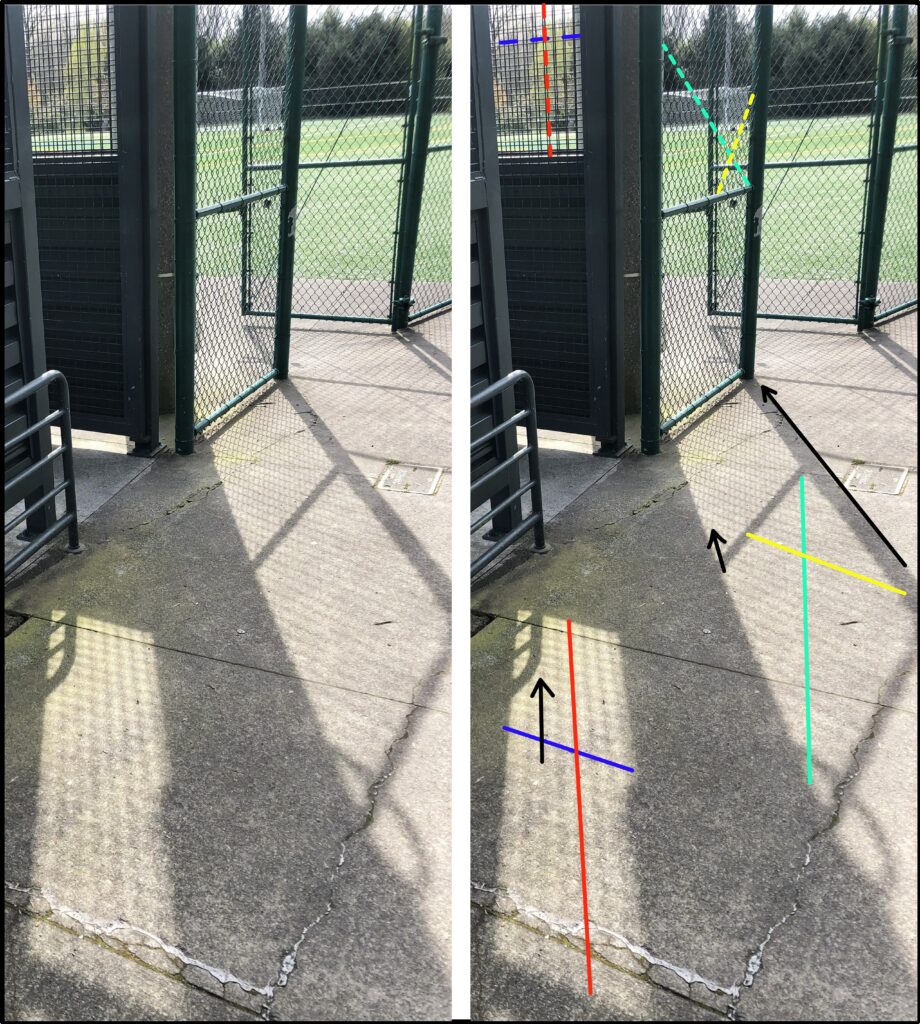
The above picture is not the best example, yet is illustrative because it shows poles and wires at various angles. First notice the shadow of the pole in upper center. The long black arrow points to the base of the pole because the base, where the shadow is closest to its object, has the sharpest shadow. The further away one goes from the object, the blurrier the shadow. The reason for the blurring is the width of the light source, the sun, as explained below. More puzzling are the shadows of the wires. Notice that the shadows from the vertical wires, an example shown as a solid red line, are slightly stronger than those from the horizontal, an example of which is marked blue (when the sun is lower, the effect is stronger). Examples of their sources are marked with dashed lines.
The thing that puzzled me were the shadows from a standard chain link fence, the green and yellow lines at right. In this case the shadows parallel to the yellow line are much more visible than the ones parallel to the green. This last case was not specifically covered by Minnaert, but he did provide a useful approach to understanding both the vertical (red-blue) grid and the slanting (green-yellow) cases. It helps by starting off with the way the shadows get projected onto the ground and how they get fuzzy with distance.
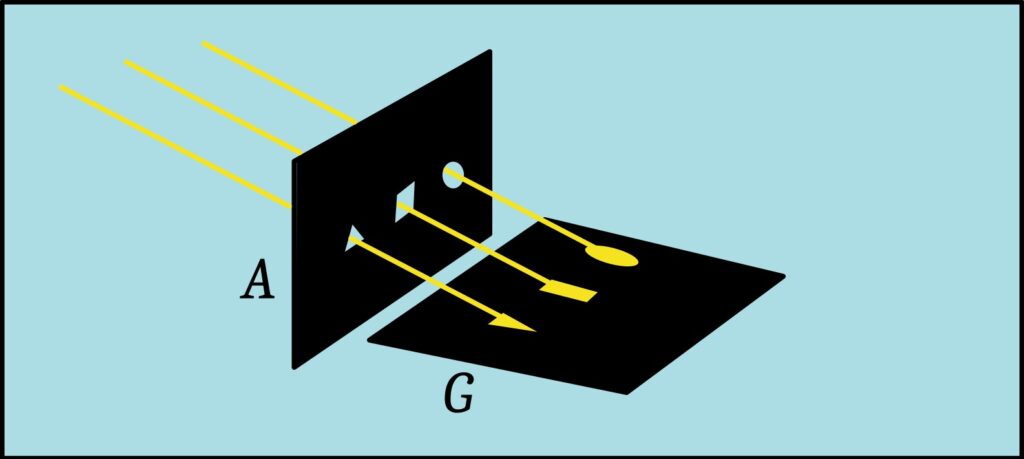
Consider first the opposite, the images from holes. When the imaging plane G, for ground, is close to the holes (see sketch above), you can see the shape of the hole clearly (here triangle, square, circle). But depending on how the ground G is angled with respect to the incoming light, the images can be elongated as shown. As the sun goes lower, the elongations get longer.
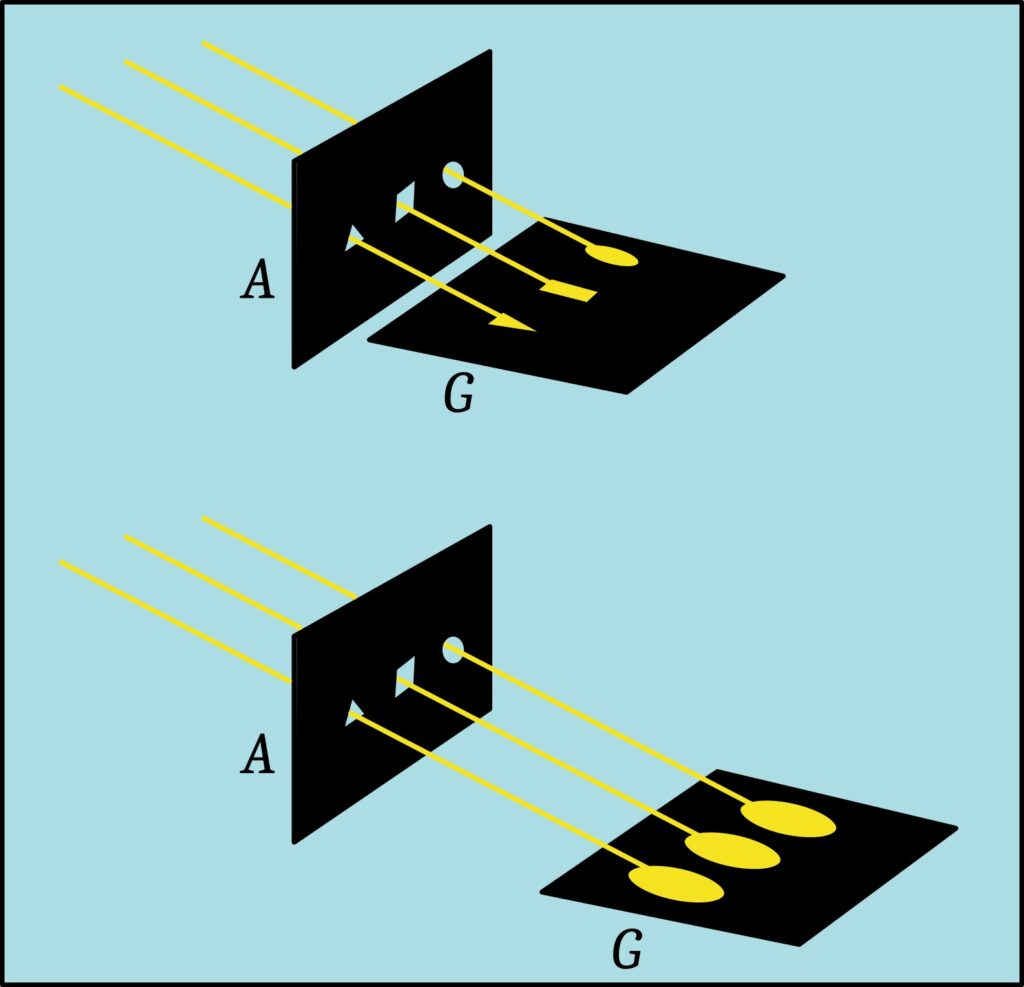
Now if the holes are far from the ground, the images all start looking the same, regardless of the shape of the hole (bottom sketch above). In fact, they are images of the sun, elongated according to the relative slope of the ground. The hole, or aperture A, is like the pinhole of a pinhole camera. Minnaert calls the naturally formed images “sun pictures”. So G above shows three sun pictures. At high noon on a level surface, they will be circles, fairly faithful images of the sun’s disc if the hole is small. See the many sun pictures when walking under a tree’s shade. Here, all the random gaps between the foliage create many holes, each making a sun picture. These are blurry because the random gaps generally make large holes, and large holes make the image blurry as described below.
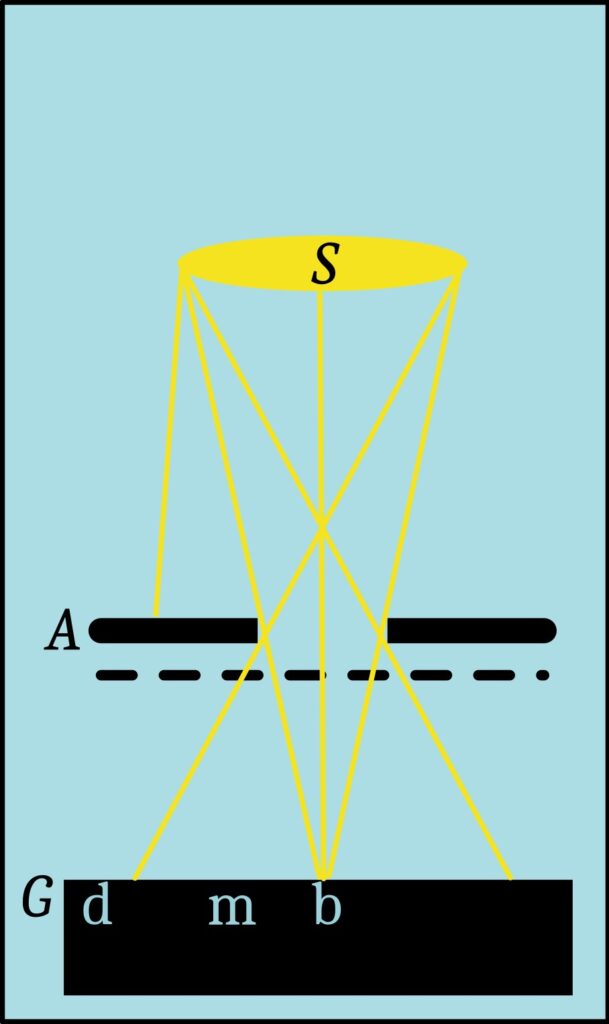
The above sketch shows the cause. Light from sun S goes through the hole in plane A (for aperture) to the ground G below. At d, the ground is darkest as no sunlight goes directly to region d. At b in the center, the image is brightest, as light from the entire sun disc reaches there, whereas in region m, the amount of light is middling, ranging from the brightest to the darkest. This region m gives the blurriness. If the ground were moved up to the dashed line, the region m would shrink, making the image sharper (but in the shape of the hole).
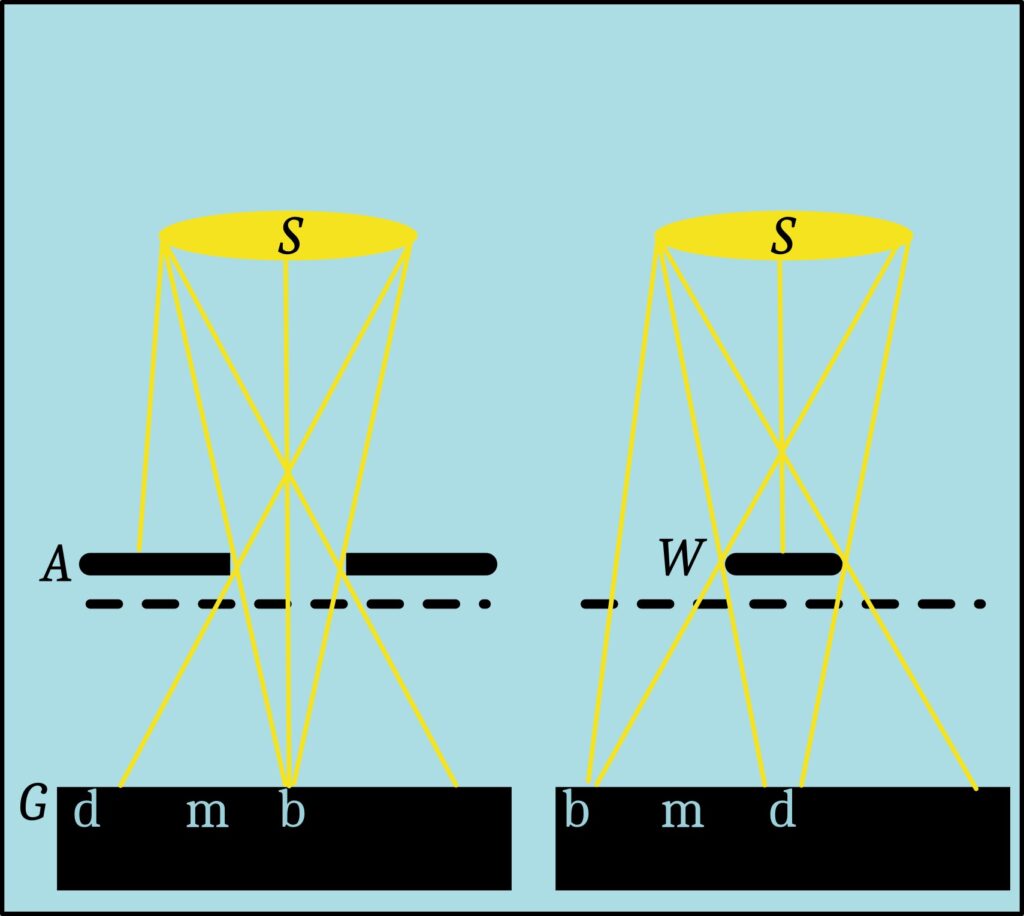
Now go back to the shadows. The same blurriness happens with the shadows except in reverse as sketched at right. The wire W blocks the light, making region d on the ground darkest, but light from the sun S passes the wire on the outside at various angles, making region b brightest and region m fuzzy. So, shadows become lighter and fuzzier the further from the wire. At the dashed plane, the shadow would be sharp as region m is tiny, but further and further away, region m spreads more and more, eventually overlapping in the middle, and at some far distance (depending on the width of W) the shadow vanishes.
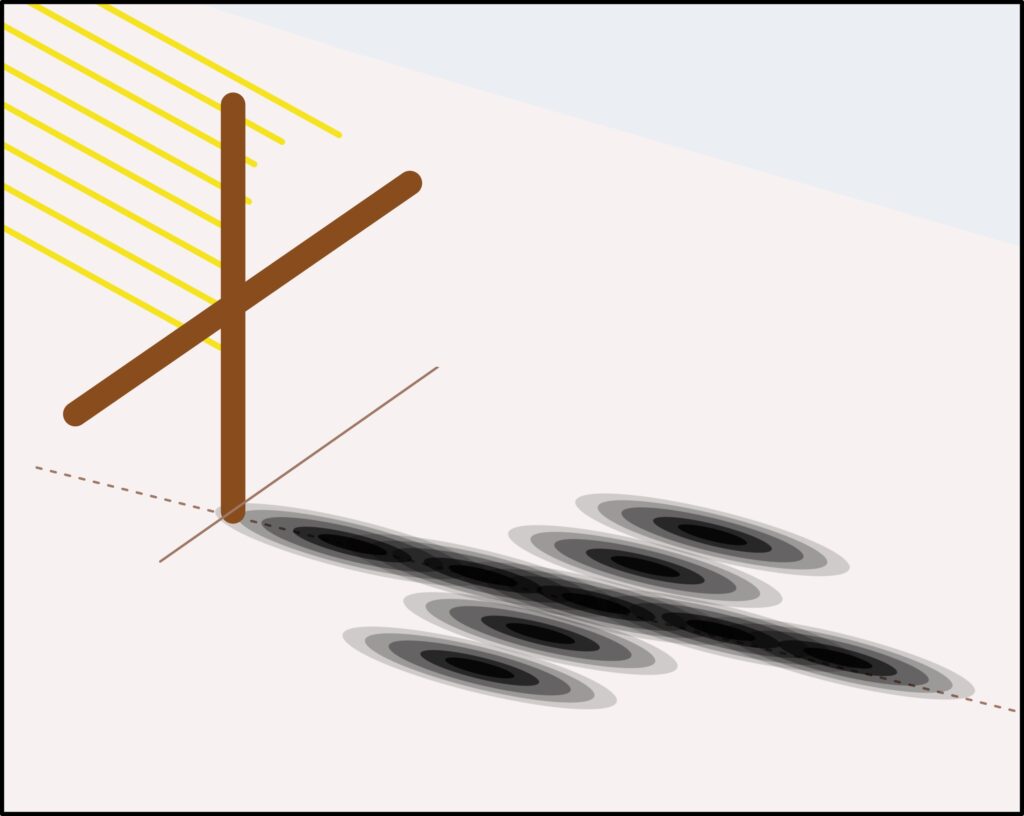
Minnaert suggested viewing the wires as a series of short segments, each making an elliptical shadow on the ground. Then add up the separate elliptical shadows to make the full shadow. By doing so, you can see the difference between a vertical wire and a horizontal wire as in the sketch above. The vertical shadow ellipses overlap, creating a clear line of shadow, whereas the horizontal wire’s shadow ellipses do not overlap much, creating a fuzzier shadow. With this model, you can see how the vertical wires make stronger shadows. You can tilt the horizontal wire up or down in the same plane, and depending on how close the wire is to the vertical, the ellipses will overlap more or less, the closer to vertical, the stronger the shadow line. Note that it does not matter if the wire is tilted up or down, it is only the angle to the vertical that matters (in this plane). So this case does not help us understand the strange shadow case we saw at top with the chain link.
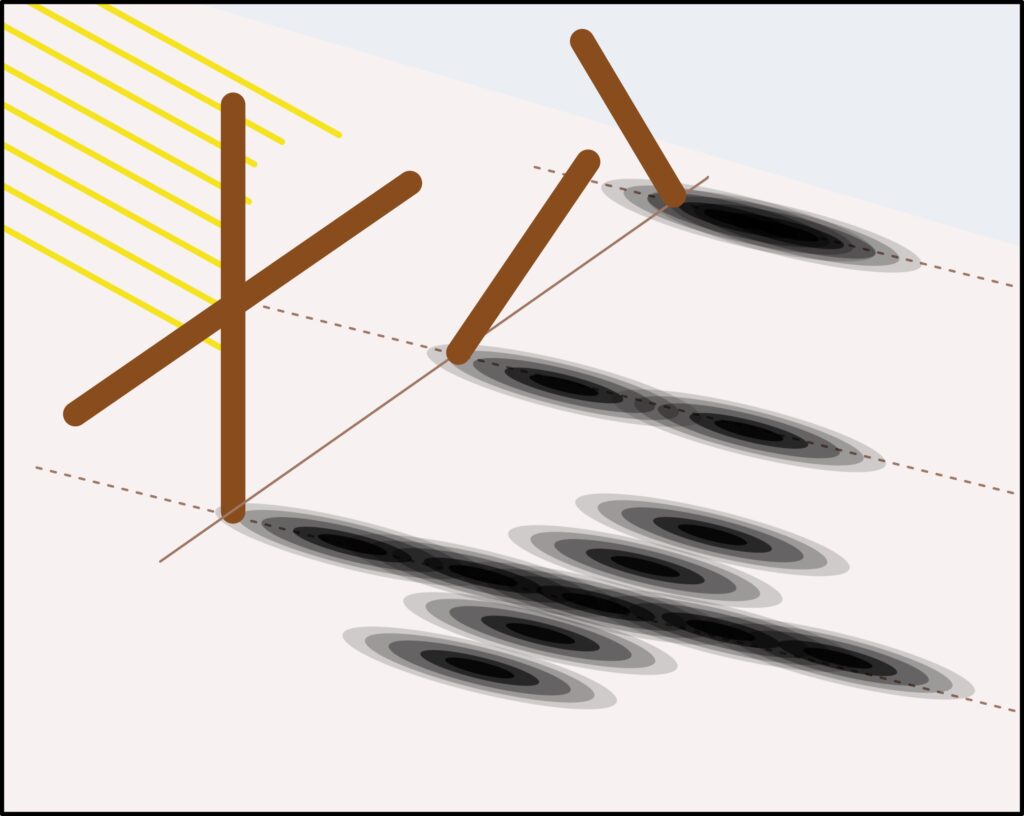
Instead, notice that the chain link fence is not oriented along a plane that is perpendicular to the sun-vertical plane. That is, the chain-link wires going up and right (the yellow dashed line in the second figure) are actually tilted towards the sun, whereas the wires going perpendicular to those (the green dashed line) are tilted away from the sun. So, they are not equivalent. What does it matter if the wire tilts into or away from the sun? Well, if we follow Minnaert’s ellipses, as in the sketches above right, the shadow ellipses for the former case (yellow, into the sun) overlap more than those in the latter case (green, away from the sun). So, from this, we can see how the yellow shadows are stronger.
This explanation may not be completely satisfactory. I struggle with it, anyway. Yet it does show how Minnaert’s method can provide a simple explanation.
A lot of writing just about fence shadows, eh? Yet maybe it will make some of those walks about town a slightly more interesting.
–Jon
*M. Minnaert, The Nature of Light and Colour in the Open Air. Dover. Often cited here.