
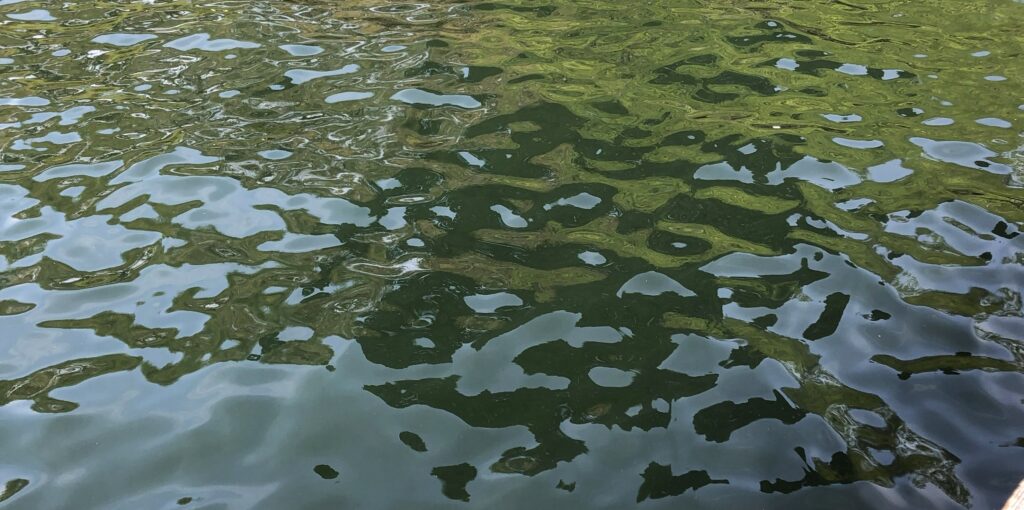
On a gently rippled lake, look near the boundary between reflections of land objects and sky. If you are close enough to see the ripples, you may be entertained by the wonderful patterns of light and dark as in the photo above.
Lynch and Livingston* call the distorted reflections of the sky within the darker region as “skypools” and the similarly distorted reflections of land (or things on land, which in contrast to sky are dark) within the light regions as “landpools”.
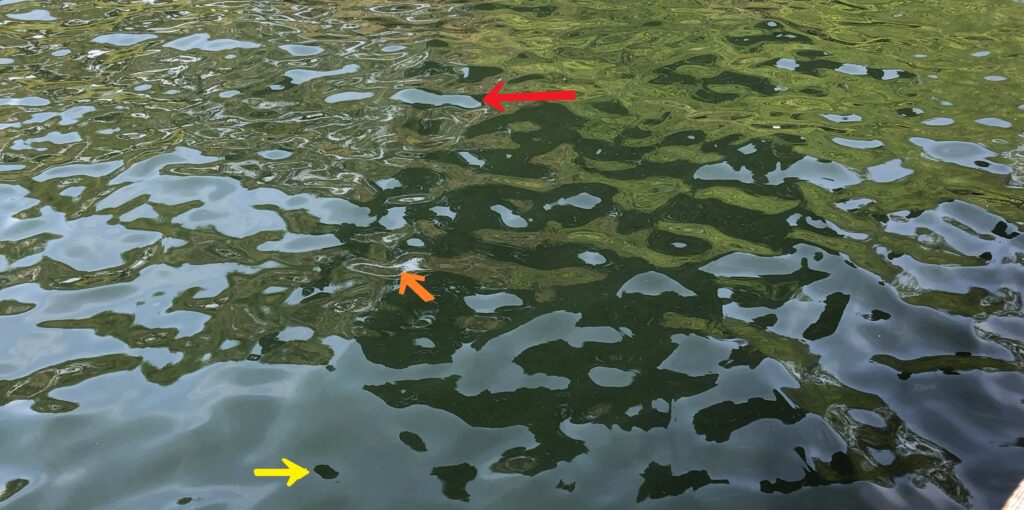
In the above annotated image, one landpool is marked by a yellow arrow, one skypool is marked by a red arrow. But what do we call the distorted light ring at orange? How about “skyloop”? Some of these light curves do not form clear loops, yet many do. They clearly exist because the water surface has hills and valleys. Lynch and Livingston argue that the skypools arise as a double-image of the sky from a concave low up to a convex high on the side of a small wave. You might, if desiring of a puzzle, try to figure out other reflections. In the meantime, here are a few more of these ever-changing patterns.

The shot below has a skypool in the shape of a duck’s head, as well as a real duck to compare to. See if you can find both duck heads!

And below shows a larger area of the same region. In the above shots, the dark patches are from trees on the shore, with one tree only about 30 feet away. The sun is behind me, but shining through a veil of cirro-stratus.

Look for them near a pond or lake near you on a relatively calm day.
–Jon
*Color and Light in Nature. Cambridge University Press, 1995.