Just rays of light bouncing off a lake…
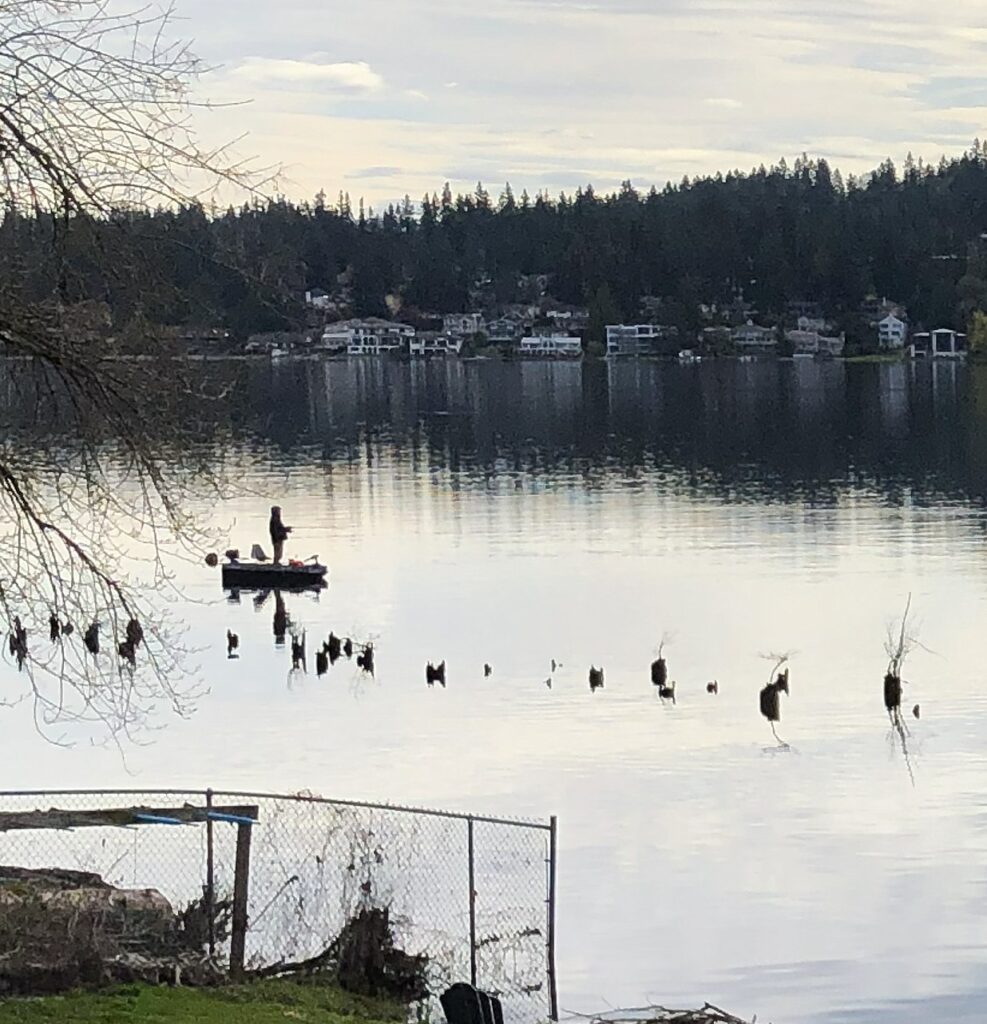
Recently while walking along the eastern shore of Lake Sammamish, I noticed the dark jagged reflection of the hillside on the water. What’s going on with those trees in the reflection? Aren’t reflections supposed to be like mirror images? They seem very stretched out.
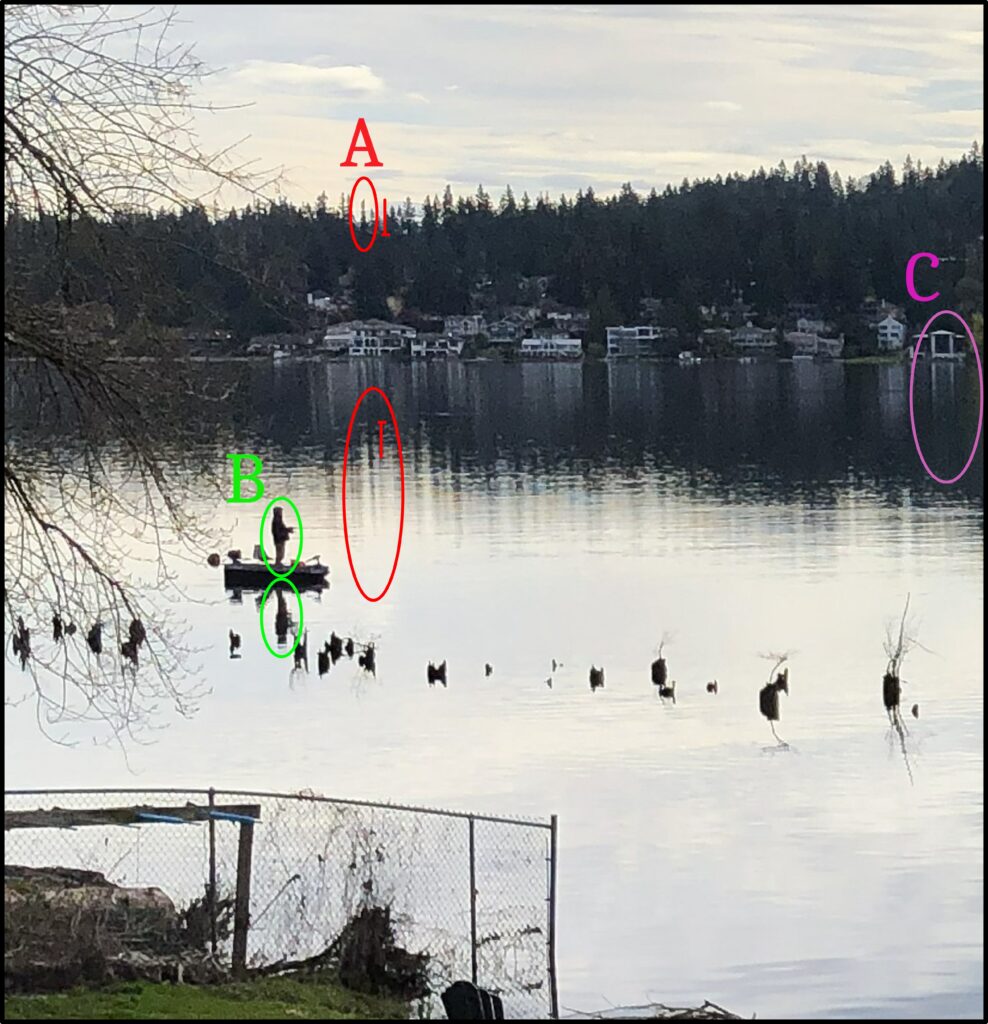
Look at the annotated version below, and how the tree circled in red at A becomes over twice as long where it reflects below in the water (larger red circle).
As a brief aside, if you ever want to have some cheap fun, try figuring out simple reflections. One such puzzle posed by the haughty is this: why is our image in the bathroom mirror reversed right-left but not up-down? I won’t answer that here*, but will instead focus on these lake reflections. You can learn something about the water waves by thinking upon their stretched-out reflections.
And for those of you who said learning geometry, algebra, and trig in school was a waste of time, prepare to be enlightened by the master. I am speaking of Marcel Minnaert, whose treatment of this issue in his uber-classic “Light & Colour in the Open Air” book supplied the derivation below.
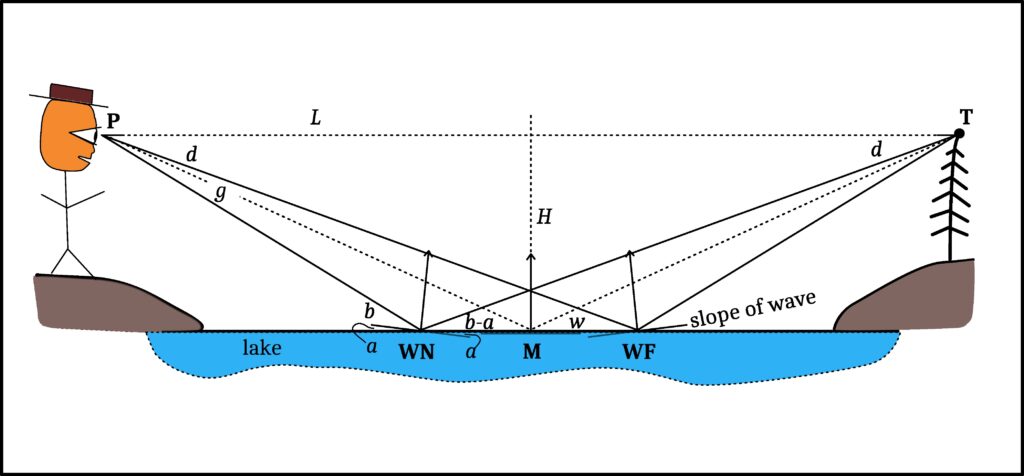
Here I am, person “P” (with a stylish hat) looking directly over at the treetop “T”. Down in the water, the surface is rippled with the water surface having its steepest surfaces at angle “a” to the perfectly flat case. Two waves are labeled: WN (nearest P) and WF (furthest). So, the waves have a slope of up to “a” degrees from flatness. The person P can see T reflected off wave WN nearest to P and wave WF furthest from P. Our goal, finding the subtended angle “g” that provides the elongation of the treetop in the water along the plane P-M-T.
Because the line P-T is assumed horizontal and thus parallel to the lake surface, we know from geometry that the two interior angles a+b and g+d must be the same:
(1) a+b = g+d .
Looking at the other side of that same wave WN, we have by the same argument
(2) b-a = d .
So, what is angle g? From (1), g = b+a-d, but from (2), we plug in d to have g = b+a-(b-a) = 2a. That is, the point T spreads out front-back by an angle g that is twice the steepest slope of the waves. If there are no waves, a = 0 and thus, g = 0 and we have a point reflection. Yet the waves spread it out front-back by twice the wave’s steepest slope.
Here’s one issue: we are not looking at a point at T, but rather the whole tree. So, we must imagine the tree as a group of points. With that in mind, I estimate from the photo that each point has spread out nearly 1/10th of the whole image. If that image is about 30 degrees tall in total, then our spreading is by about 3 degrees. This means that the waves are tilting from the horizontal by only about a = 1.5 degrees. It doesn’t take much, does it?
But why is the reflection stretched only in the front-back direction? To picture how this works, think about how the light path from T to M to P stays in a plane. As you recall from geometry, three points define a plane. For the spreading out sideways, we must tilt our planes. By how much? Well, for the light to reflect off the wave in the new plane, the reflection point must be a plane perpendicular to the light path, just like it is in the case considered above (that is, plane M is horizontal. Thinking this way, you should come around to the idea that the planes tilted side-to-side must be tilted by a maximum of “a”, the steepest part of our wave.
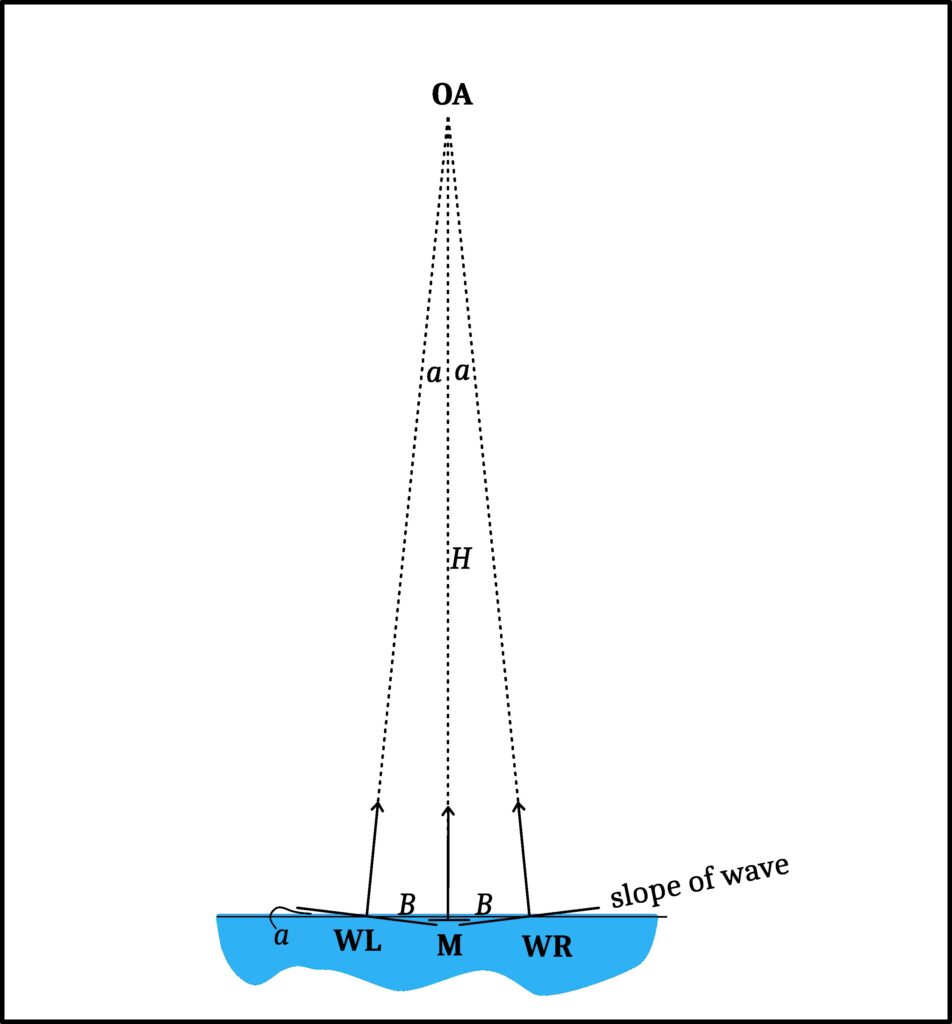
To estimate the width of the reflection side-to-side, we then need to know the separation of the waves in the sketch above, or 2B. The height H is the distance to the water below the line P-T across to the tree from observer P. Here, we must use a little trigonometry to get 2B = 2H*tan(a). The angle we see the point T spread across side-to-side is then the ratio of this distance 2B to the distance the observer is to the reflection, or P-M. From the Pythagorean theorem, this distance is the square root of the sum of the squares of the sides of the triangle P-OA-M, or L^2 + H^2.
What is more useful though is the aspect ratio, that is how much a spot of light spreads out side-to-side divided by the amount front-back. This ratio can quickly be found from the above to be equal to sin(w), where w is the angle to the point M in the top sketch. So, if we are very low and close to the water, the point is stretched out essentially into a line (sin(w) = 0), but if we are directly above looking down the image spreads equally in all directions (sin(w) = 1). That checks out with experience, good.
But the reflection of the fellow in the boat (circled green at “B”) is hardly stretched out. Why? This case is a little different from the above analysis as the line from me to him slants down into the water. Nevertheless, we can understand a few factors that lead to less spreading. (I) Being closer means that a given angle will not show as much spread. (II) The angle w is larger. And (III), being nearer to shore often means that the waves are gentler, so angle a is smaller.
Also notice how vertical lines and horizontal lines reflect differently. Because the vertical ones are composed of points that tend to superimpose on each other when elongated, they show up clearly. In contrast, the horizontal ones do not superimpose and thus get washed out. Note the case circled in purple at the right side of the picture (“C”).
Of course, much more can be said about reflections in rippled water. Later.
— Jon
* Actually, here’s the answer. The question is phrased wrong. There is no reversal of left-right. You have been misled by sloppy talk. The mirror instead inverts the image, front-back. To see this, imagine putting a rubber band on your left hand. In the mirror, you see the rubber band on the hand that is also on the left. But it is inverted to now be facing the other way. Clearly, it is not your right hand because your right has no rubber band. The temptation to call it your right hand is that it looks very similar to that which would occur if your duplicate could step behind the mirror and turn around. In that case, your duplicate’s right hand would now be on the left. But it is not your right hand. It is just your comparison made confusing by the fact that you have a left-right symmetry.
So, we are tricked by a combination of sloppy popular-science/math reporting and our own symmetry. Ponder this: If instead our left and right hands were very different, say, one is huge, the other small, yet our head looked similar to our feet, what would we say then? I don’t know, but I’ll tell you what the sloppy reporter would say “Why does the mirror reverse up-down and not left-right?”