
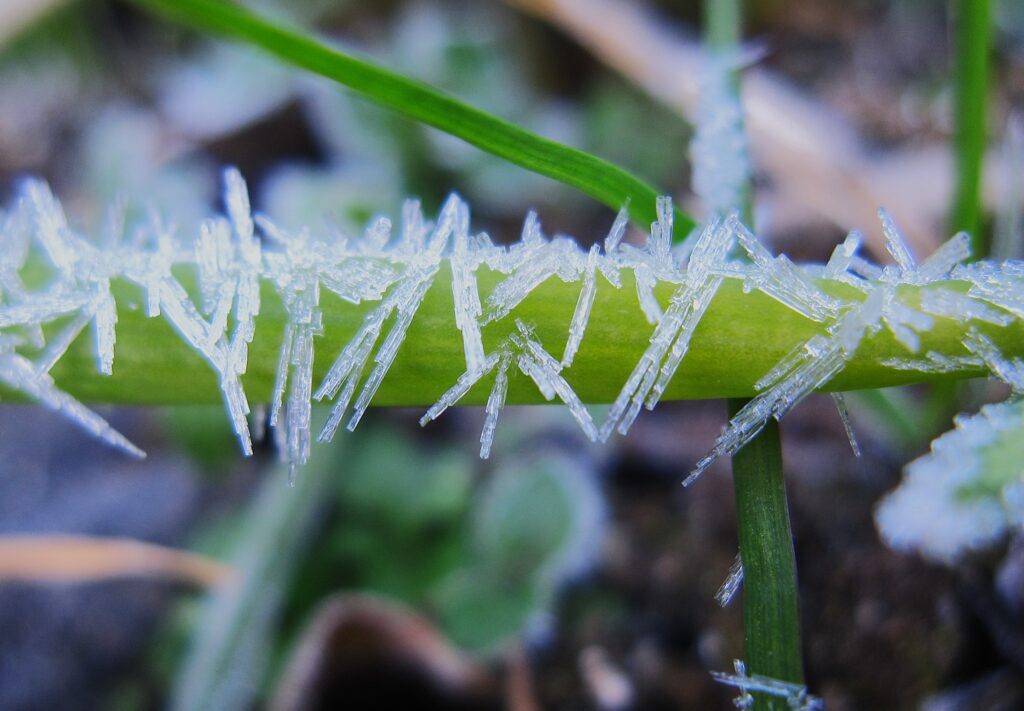
Are winters getting too warm for ice? Is the “ice-watcher”, a person like me who delights in seeing swirly film frost on surfaces or hair ice from wood, doomed? Seeking an answer, I decided to count cold days. Consider the “frost day”, defined as a day in which the temperature near the ground goes below freezing. Back in 2013*, I analyzed long-term temperature data in my state (Washington) for the trend in frost days per winter. Their number was in decline, though not by much. As the global temperatures have continued to rise since then, with the ten highest surface-average temperatures all occurring after 2014, it seemed like the number of days of sub-freezing temperature should have taken a nose-dive. Did it? Let’s look at some data**.
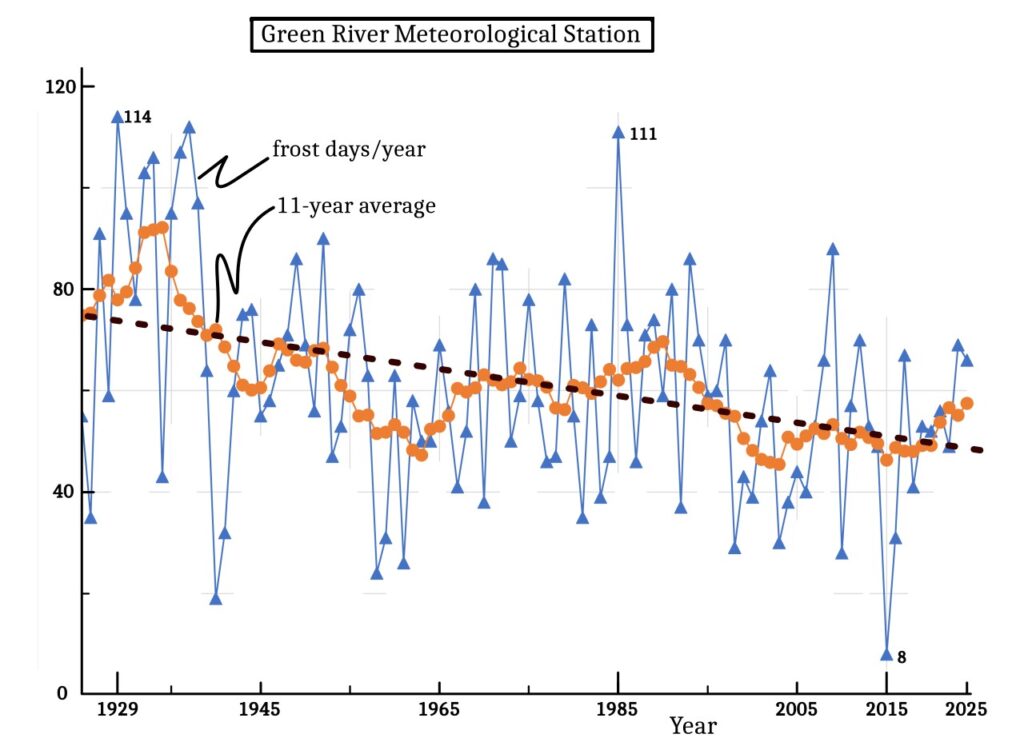
The weather record at Green River (notorious in the 80s***), as shown above, indeed shows a decline over the past century. But look how the number of days changes wildly from year to year–over periods of a few years, this number changes by about 40 days per winter. Over the past 40 years, the mean number of frost days is 50-60, yet there are peaks twice as high (111 in 1985) and about 1/6th as high (8 in 2015). The poor ice-watcher in 2015 must have been very disappointed having only 8 days to possibly observe some ice on the ground (such as the hoar frost on grass in the photo at top). Only two years later, our ice-watcher could experience nearly 10 times as many frost days and perhaps could be forgiven for thinking that glaciers may soon arrive. The wild changes suggest a message: Do not despair over one year’s weather, as the next year is often quite different.
Getting back to our original question: If we try to fit a linear trend, as shown by the dashed black line, we have on average about 25 fewer frost days per winter now as we did in 1925. With the number of frost days oscillating about 50 per winter now (2025), that suggests that we have about 200 more years of reliable ground-ice observations around the Green River. In the long-term scheme, this is terrible news, yet it also suggests that the next few generations of ice-watchers here need not panic.
I will soon post up trends in other locations. Strangely enough, not all locations show a decline in frost days. As another teaser, let me remind readers that not all ice is on the ground. Some ice lingers in the atmosphere and even when that ice never reaches the ground, we can still observe it indirectly. So, the answer to the title is “no”. It is not that I do not consider anthropogenic global warming as a serious issue to address: I do believe we owe it to later generations to leave the earth as undisturbed as possible. Yet I think this finding suggests that we do have time to calmly take action, and such actions, though slow, can ultimately help.
— Jon
*https://www.storyofsnow.com/blog1.php/frost-days-and-ice-days-declining-numbers-over-the-century
**https://www.ncei.noaa.gov/cdo-web/ . From this page, click the search tool, select daily summaries, approximate date range, and a station or city name. After another page in which you select daily minimum and maximum temperature, they will then send the data in the CSV format that you can analyze with Excel. Here, I had Excel count the days with a temperature minimum below 33 F.
Then to the location. It depends on the data range.
***Lookup the Green River Killer.