
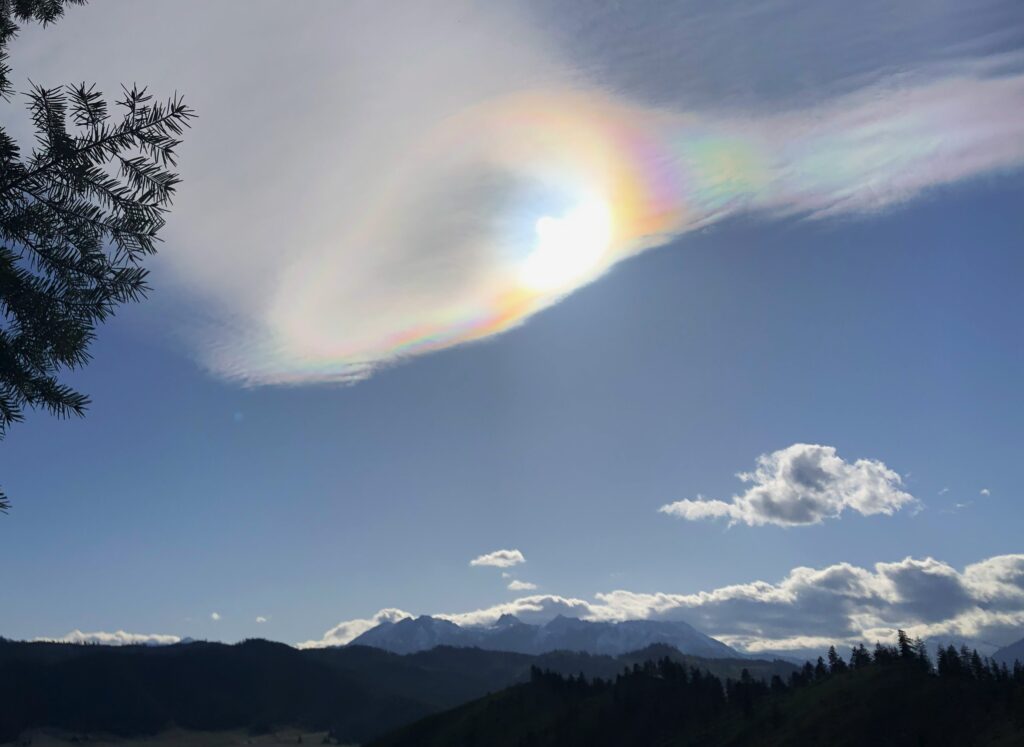
The name is descriptive yet misleading. The colored edges of some clouds indeed look a lot like the colored interference colors in a soap or oil film, which is what physicists call iridescence. Yet in the cloud case, the effect is due to a slightly different phenomenon—diffraction. The diffraction occurs around many tiny cloud droplets.
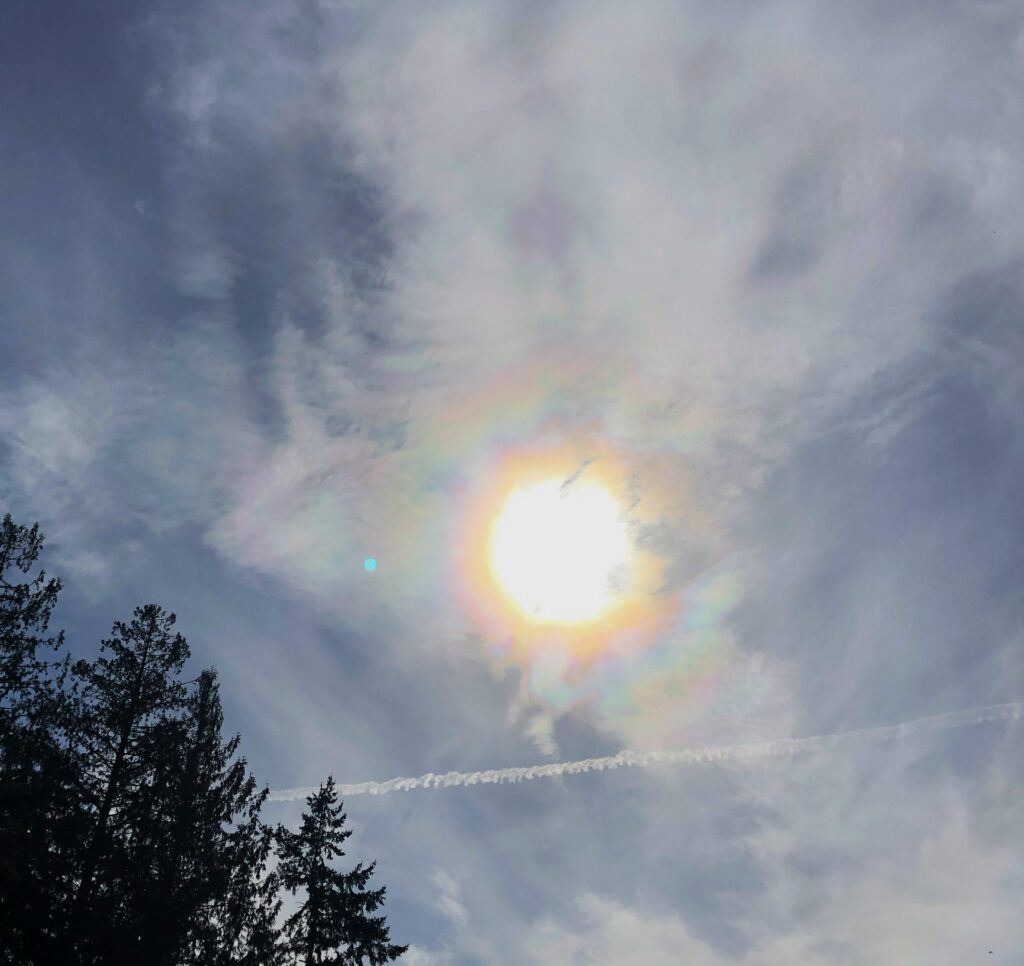
No matter. The important thing is that the colors can be stunning to look at, particularly if you have dark sunglasses (because they generally appear near the bright sun). The top photo of this post came from a case I saw mid-April last year. When I mentioned it to my climbing partners, they noticed it immediately. The memory of that trip came back when I saw a similar case yesterday, though not quite as stunning (below). Although the effect is nearly always due to small water droplets, there has been at least one case in which the colors have been attributed to very tiny ice crystals.
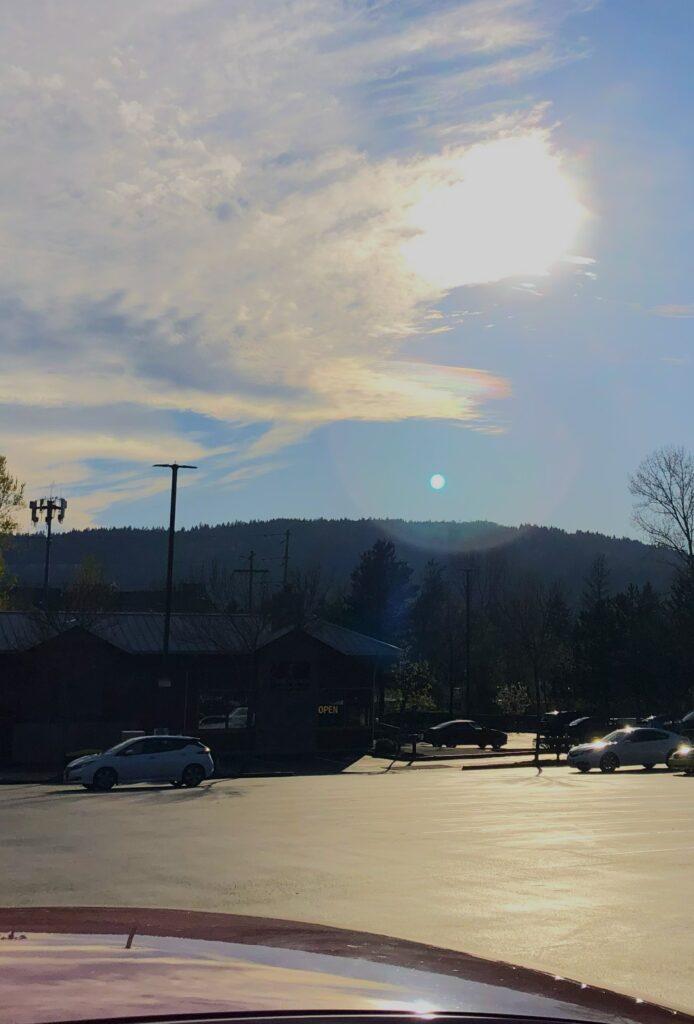
When I first noticed it yesterday, the photo I took of it also shows a faint ice-crystal halo, which I am sure came from a different cloud at a higher elevation. See below.
How high are those clouds? If one wants to get a fair estimate of the height of some high-level clouds, one should look at an atmospheric sounding for that day*. The sounding for yesterday morning is shown below. The sounding plot suggests a lowest cloudbase at about 470 mb or about 6 km high (3.7 miles) and a temperature of about -27 C (-16.6 F). These conditions are consistent with small cloud droplets, though some ice would also likely have formed. To find the likely height of the cloud base, look where the red temperature curve touches, or nearly touches, the blue dewpoint temperature curve. The basic physical idea is that when air cools to the dewpoint, droplets can form.
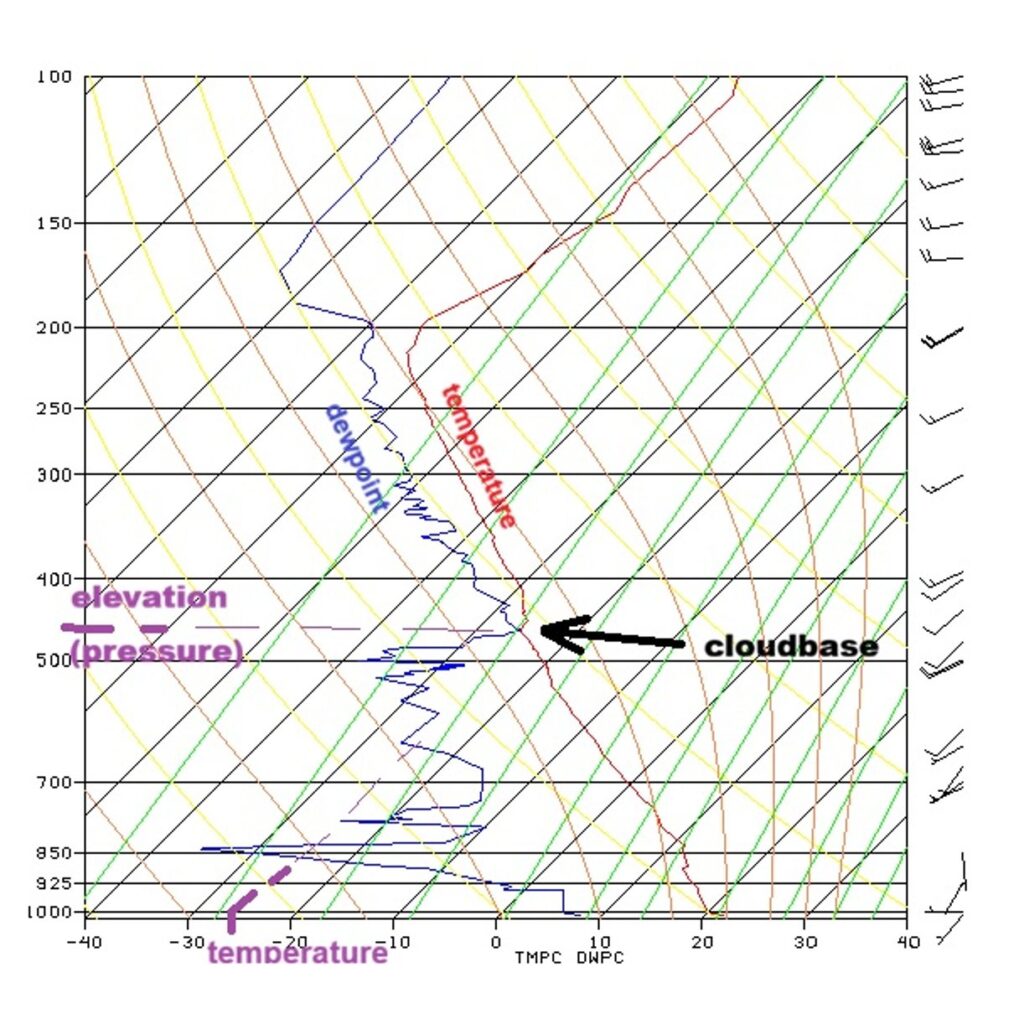
Soundings give a lot of useful information about the atmosphere and thus are used often by good meteorologists. That wouldn’t be me, though I should try harder.
The cloud iridescence looks similar to the reflection iridescence one sees in oil and soap films (also some bird feathers, and shells) because in both cases, different colors can mix. The mixing makes colors different from what you can see in simple spectrums such as in a rainbow or CZ arc. With the mixing, some mixed colors have a metallic luster. More interesting aspects of cloud iridescence will wait to a later post.
— Jon
*One site is https://www.ready.noaa.gov/ready2-bin/sonde.pl Here, you must input the location of the sounding launch. One place to find site locations with their name-number is https://www.raob.com/assets/downloads/raob.stn.txt . One site to help explain how to read the plots is here: https://wildcardweather.com/2015/02/21/learn-to-read-a-skew-t-diagram-like-a-meteorologist-in-pictures/