
A few days ago (Mar. 28), I described the decline in frost days at the Green River station in Washington State. What about other locations? And what are “ice days”? Read on.
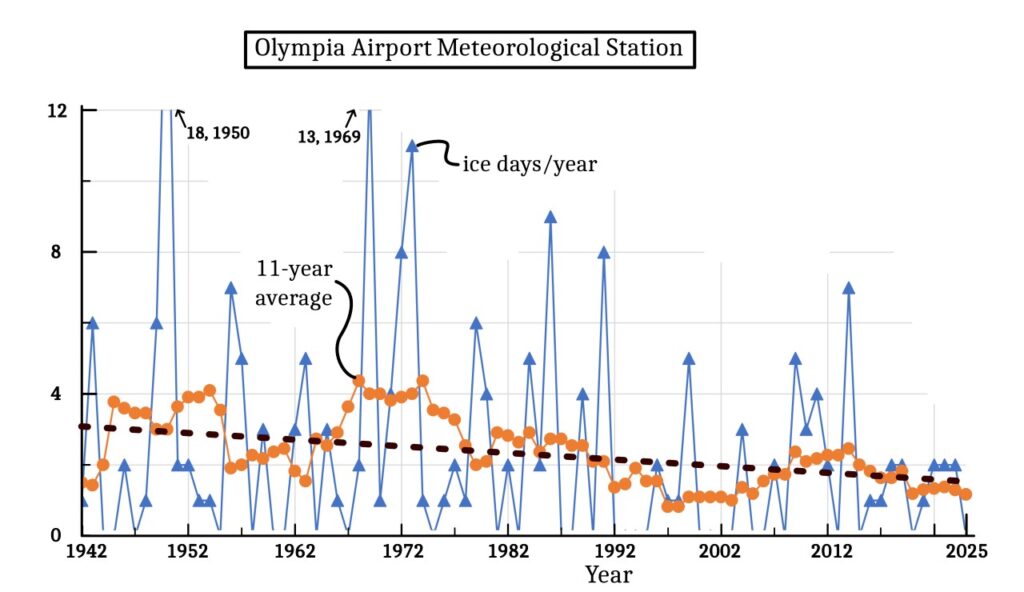
An ice day is a day in which the maximum temperature is below (or at) freezing. It differs from a frost day in that the latter only requires a minimum temperature at or below freezing. Thus, every ice day is also a frost day, but on a frost day, the ice may melt during the day. So, if you want to ice skate on a pond, you will probably want to have a lot of ice days.
This is probably not a great place for ice skating outside.
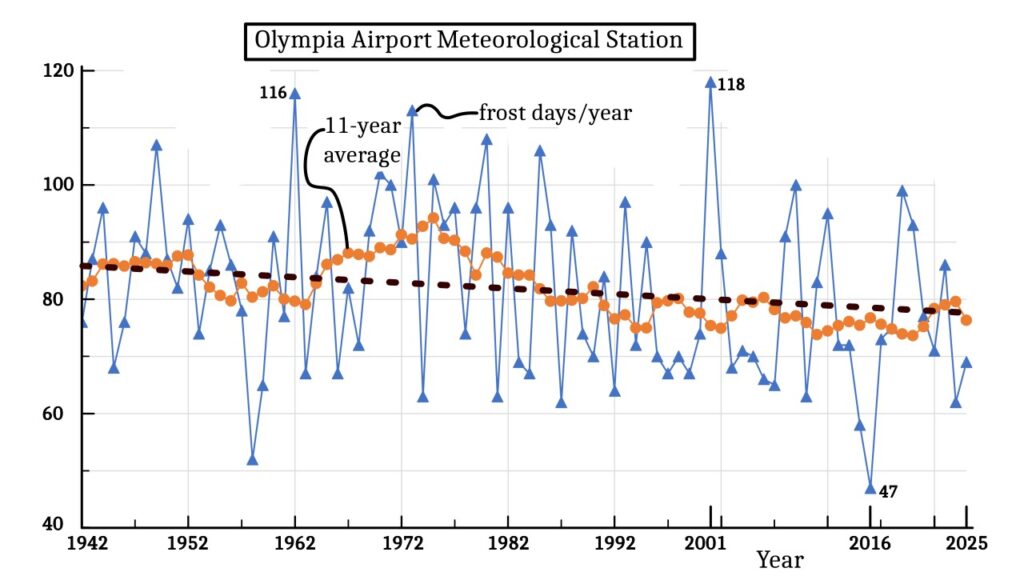
The plot that heads this post shows that the number of frost days at Olympia is now about 78. This number is roughly 40x larger than the current (2025) number of ice days as shown in the plot just above. Thus, the temperature nearly always warms up above freezing during the day.
Another curious thing about Olympia is that it has over 50% more frost days than that at Green River (now 50). Having 50% more is odd, for not only is Olympia further south than the Green River station, it is also closer to a large body of water (Puget Sound), which should moderate the temperature fluctuations and moreover lies at a lower elevation (60.9 m vs 280.4 m). See the relative locations in the map below (Olympia = Oly, Green River = Gre; underlying map from Wikipedia Commons).
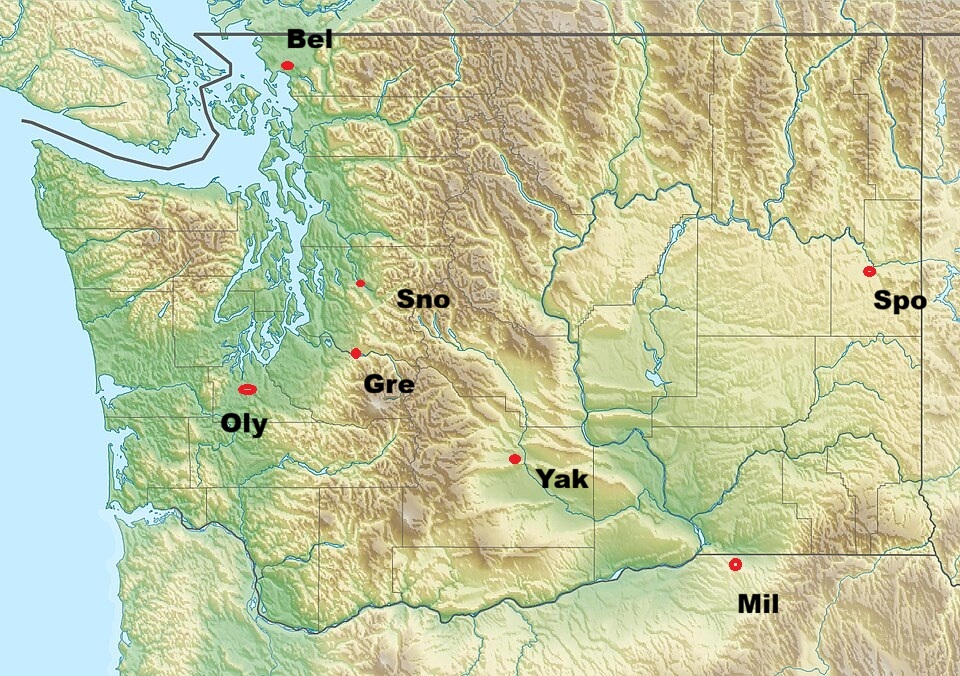
Locations of analyzed frost and ice days.
The reason Olympia has so much more frost than Green River may partly be due to their “microclimates”, which is all about how the details of the local surroundings can influence the local climate (e.g., being in a narrow valley with much shade) and weather. Yet the bigger factor in these cases may be larger-scale air flows. Proximity to large features such as a body of water also can be a factor. For instance, the station furthest north on my map is Bellingham (Bel), yet is has roughly the same number of frost days as Green River (Gre), much further south, probably because Bellingham is right on Puget Sound:
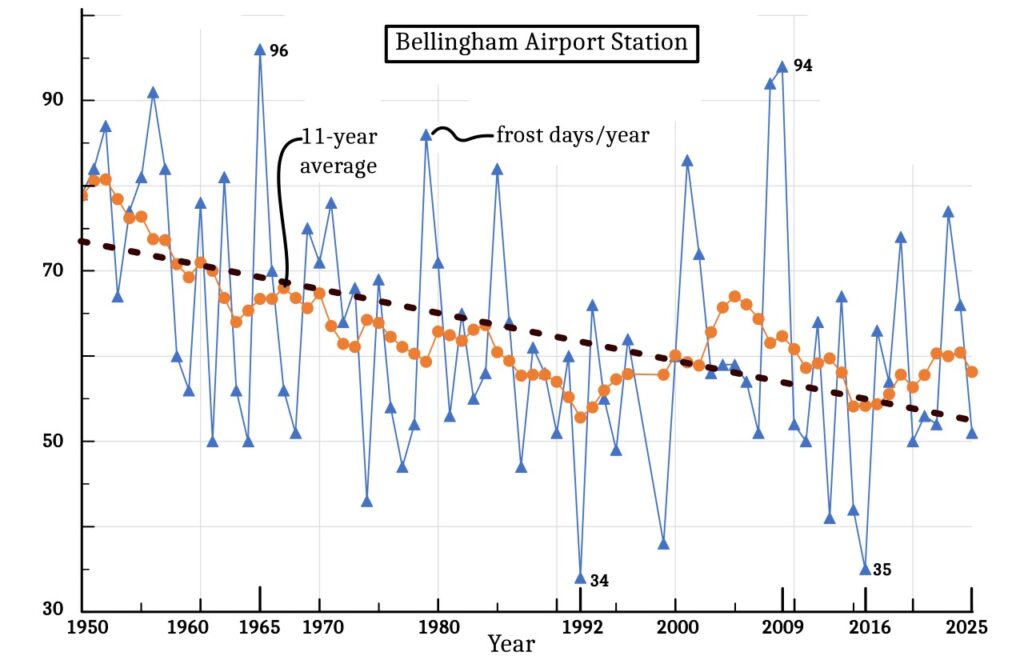
In fact, Gre and Bel also have nearly the same decline over the past century or so: If we extrapolate their data into the future, one location is estimated to have 200 years before essentially all frost is banished, whereas the other is essentially the same at 199 years. Is this the general prediction for all stations? Not by a long shot. Consider the stations with the three next-highest number of frost days. These three are Snoqualmie Falls* (Sno), Milton-Freewater (Mil), and Oly. Oly has been shown above, below are Sno, a station only 15 miles from my house, and Mil, which is actually in Oregon:
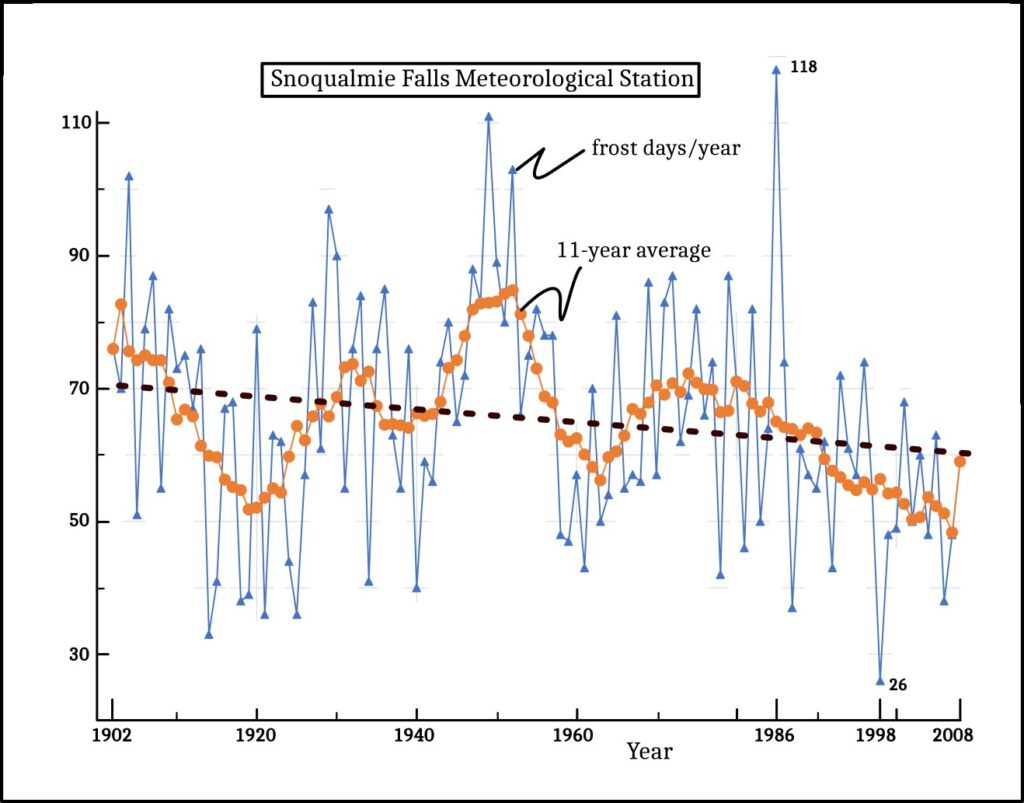
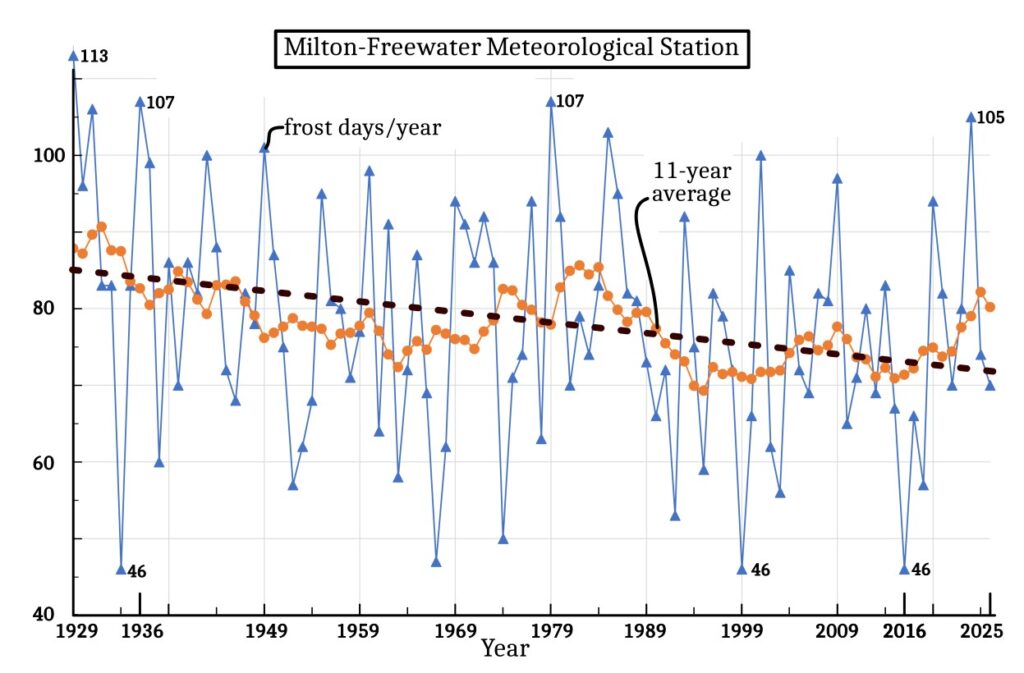
What are the predictions from these stations? Quite a bit more than 200 years: Sno = 647 years, Mil = 532 years, and Oly = 719 years. (For a real shocker, stick around to see Spokane’s case below.) I don’t believe these numbers really mean much except to say that frost is unlikely to vanish for anyone alive today. So, as I concluded in the earlier blog post, I am not panicking about our warming winters. Yet I do think we should take steps to reduce our rate of warming. For one thing, in many locations, the ice days will vanish in many of our lifetimes. For instance, in the case of Oly, we saw that many years already have zero ice days. The trend line for this location crosses the axis of zero in 73 years though to be down to only two days on average means they are already essentially gone. In other locations of Washington (not shown), the crossing to zero is even sooner.
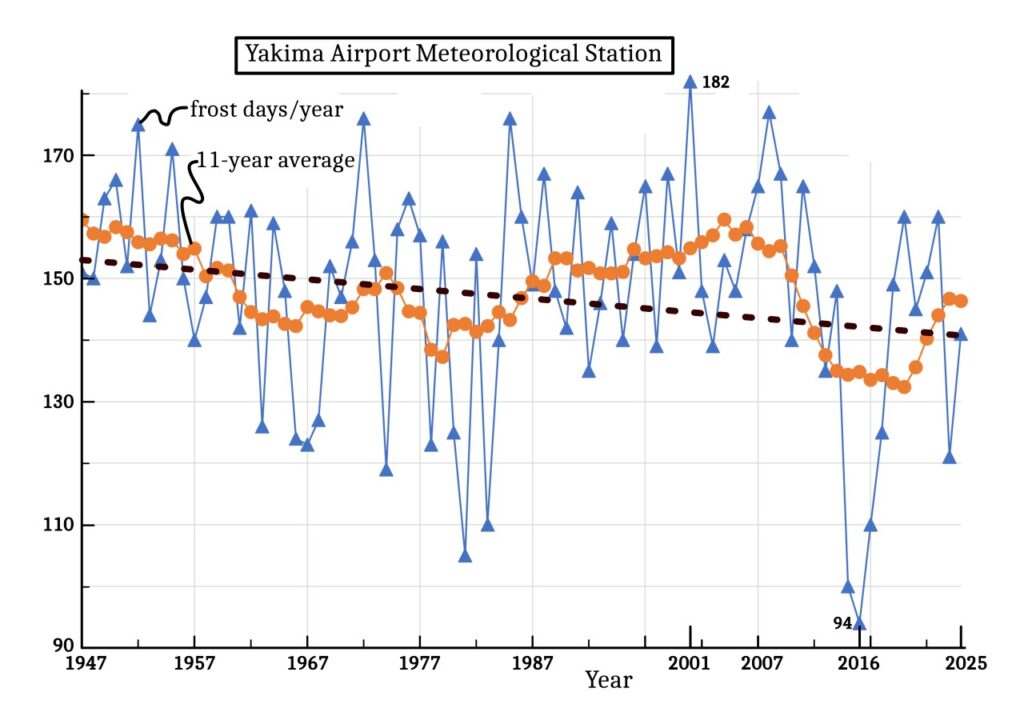
Of the seven locations examined here, the one with the most frost days is Yakima, plotted above. Presently at about 141 after having lost about 12 days per winter over the past 78 years. At this rate, there will be frost days for another 916 years.
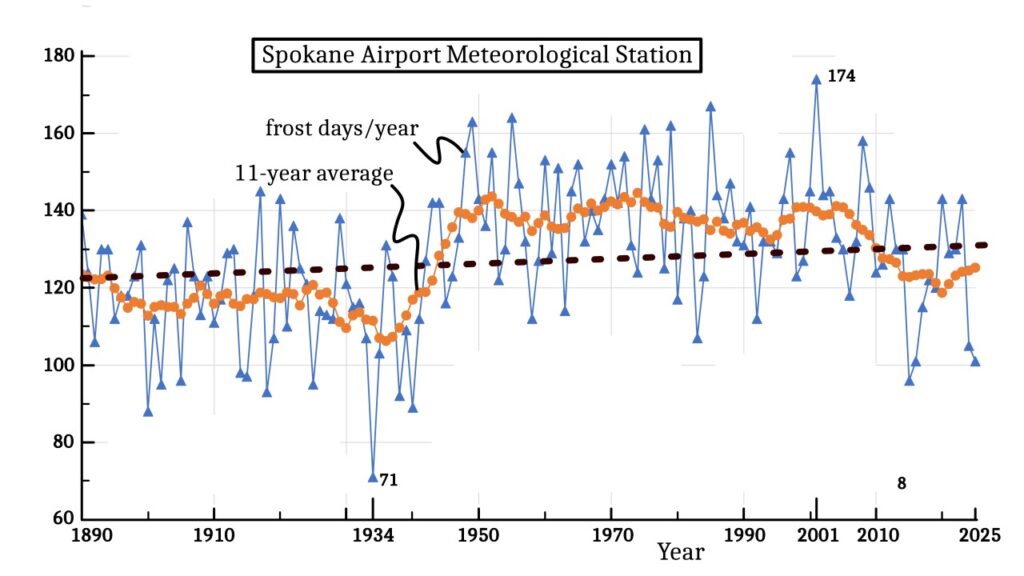
Finally, what about Spokane? Here, the numbers actually seem to be increasing.
Ditto for the number of ice days.
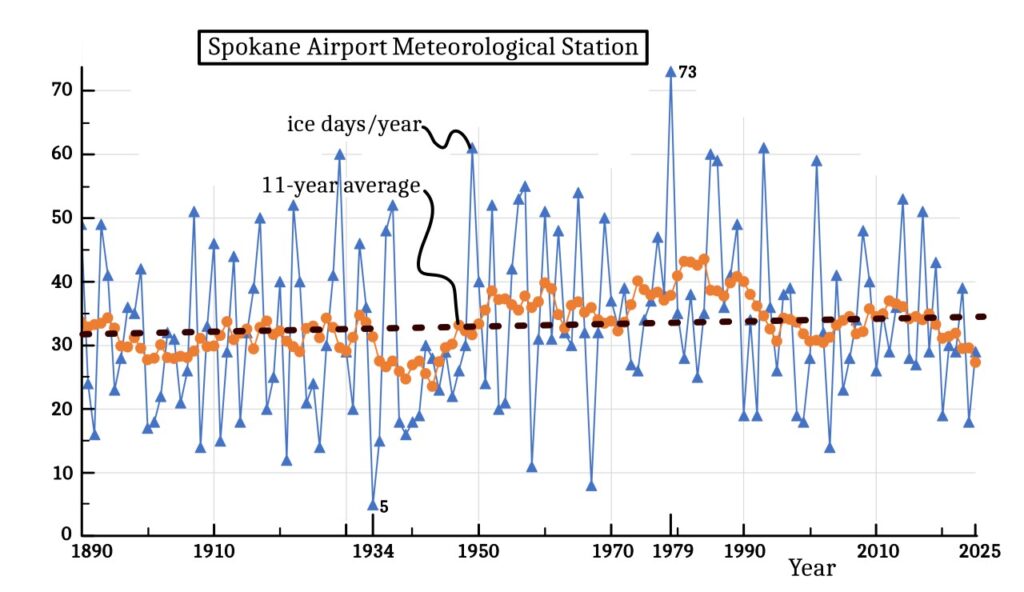
But are the trends really increasing, or is there something else going on?
If we ignore the shift between about 1934 and 1950, then the pre- and post-shift frost-day trends decrease at a rate consistent with Sno, Mil, and Oly, giving a zero year in about 650 years. I suppose that, as we suspected with the Oly-Gre puzzle, that the local microclimate greatly influences the number of frost days. According to Wikipedia, Spokane airport became a major training base for the Second Air Force during World War II and then became the city’s municipal airport in 1946. So, there were changes occurring at the airport during this period of frost-day increase and perhaps the land-use changes were significant enough to change the daily low temperatures. The similar-but-smaller shift in the ice days is harder to explain as a land-use change because it involves a shift in the daily maximum temperature. However, it is possible that the increased use of aircraft during this shift period led to a slight increase in daytime cloudiness. Conceivable, yet just a wild guess.
— Jon