
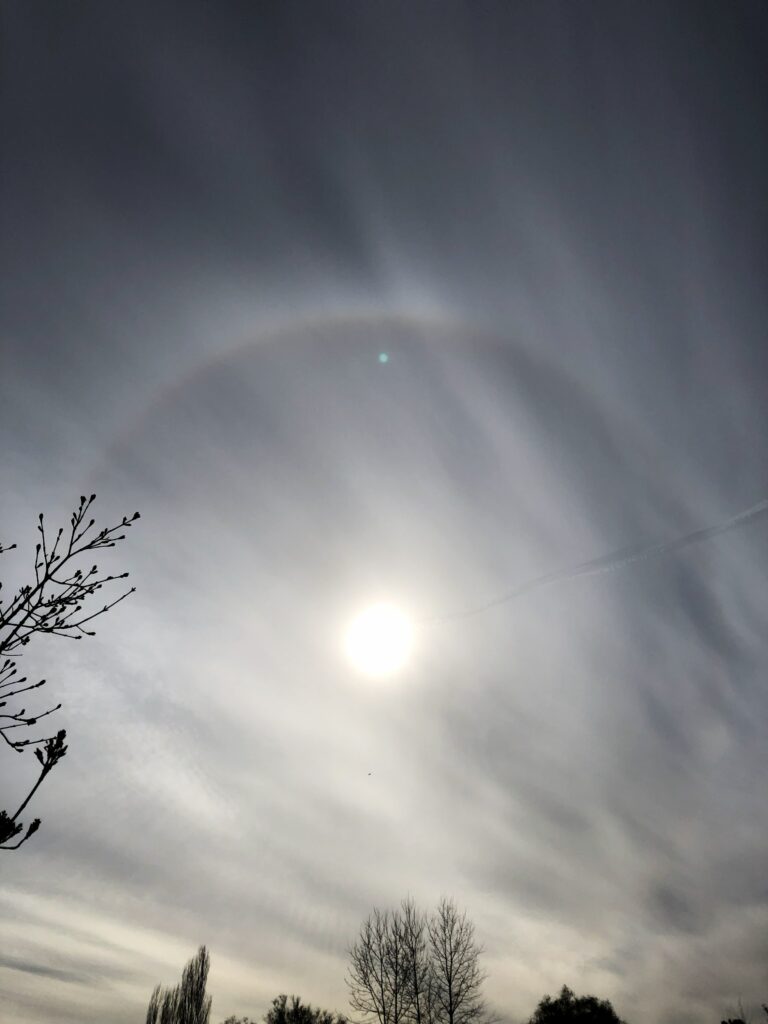
The book that I’ve turned to most often over the years is Minnaert’s “The Nature of Light & Colour in the Open Air”, which describes many interesting and sometimes rare things to observe outside*. And for me the most memorable part of that book is his introduction to halos (example in the picture above):
“After a few days of fine bright spring weather, the barometer falls and a south wind begins to blow. High clouds, fragile and feathery, rise out of the west, the sky gradually becomes milky white, made opalescent by veils of cirro-stratus. The sun seems to shine through ground glass, its outline no longer sharp but merging into its surroundings. There is a peculiar, uncertain light over the landscape; I ‘feel’ that there must be a halo round the sun!….And as a rule I am right.”
This halo is small only in the sense that larger ones exist, though those are much less common. He goes on to say that in his region of the world (The Netherlands), a dedicated observer may see one on 200 days of the year. Few have time to be dedicated to observing, but if you consider his description above, you’ll have a good sense about when to go outside and look, increasing your chances considerably. The halo pictured above is one I saw two days ago.
Minneart’s book was quite influential, inspiring many in the years since publication, including one book with a similar title (also highly recommended) “Color and Light in Nature” by David K. Lynch and William Livingston. I remember meeting Bill Livingston when I was at the University of Arizona back in the 90s. During that time, I also attended one conference named after Minnaert’s book. At that conference, I gave a talk about one reason why we don’t see a halo despite the presence of ice. It was an interesting time that I will write about later.
— Jon
*Dover, 1954